
Capturing Highways in the Mountains With FlyCart 30
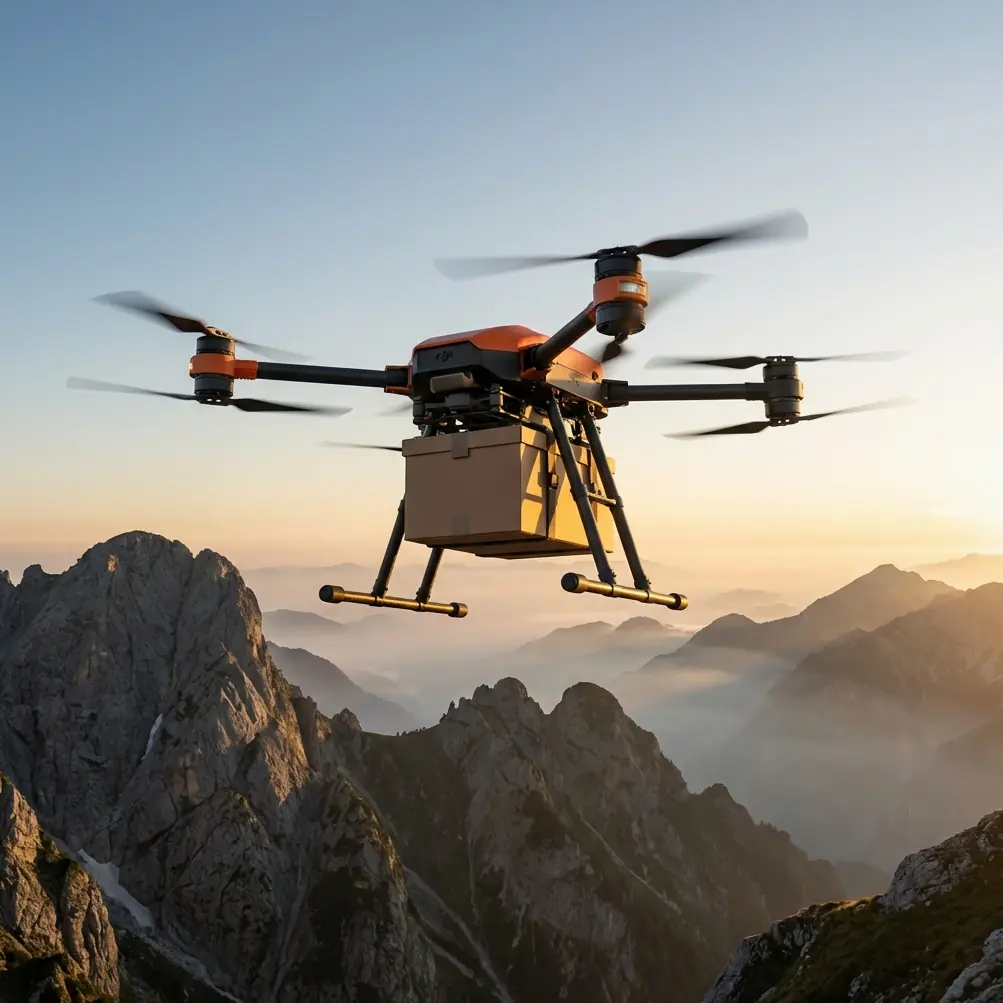
Capturing Highways in the Mountains With FlyCart 30: What Quiet Drone Delivery Expansion Really Tells Us
META: Practical FlyCart 30 field guidance for mountain highway operations, with antenna positioning, route planning, payload strategy, and safety lessons drawn from real drone delivery expansion in the U.S.
The most useful signal in drone logistics right now is not a flashy demo. It is the opposite. Quiet expansion.
A recent report on the U.S. delivery market pointed out something many operators already sense from the field: drone delivery companies have moved beyond novelty. After years of testing and millions of deliveries, firms such as Zipline are pushing into new American markets, including a planned Phoenix-area autonomous launch later this year. The headline detail is not just geographic growth. It is how they are growing: with an emphasis on safety, consistency, and suburban reach.
That matters if you are evaluating the FlyCart 30 for mountain highway work.
On paper, “capturing highways in mountain” sounds like an imaging task. In practice, it is a logistics problem disguised as a camera mission. Long corridors. Broken terrain. Unfriendly wind. GNSS variability near rock faces. Limited staging areas. Pressure to move equipment, sensors, batteries, or support payloads to hard-to-reach points without closing lanes longer than necessary. The aircraft is only one piece. The real challenge is building repeatable operations in an environment that does not forgive weak planning.
That is exactly why the broader delivery market is worth studying. When an industry reaches millions of completed sorties and still talks first about consistency, that is a clue. It tells us what actually separates field-ready operations from one-off flights.
The mountain highway problem is not distance alone
Teams new to FlyCart 30 often focus on maximum range first. In mountain corridors, that is too simplistic.
Range gets eaten by terrain geometry. A route that looks short on a map may be radio-hostile because a ridge interrupts line quality between the remote controller and the aircraft. A downhill segment may reduce power demand in one leg, then force a heavier climb on return. Wind does not travel evenly through valleys; it compresses, shifts, and spills over cuts in ways that can turn a stable cruise segment into a high-correction workload.
For highway capture projects, especially where equipment needs to be inserted at multiple points along an elevated or winding road, the FlyCart 30 becomes valuable not because it is merely a cargo drone, but because it can help separate personnel movement from payload movement. That difference affects both safety and tempo. Instead of repeatedly sending crews over unstable shoulders or down embankments with gear, the aircraft can place items closer to the work zone while the team remains staged in a more controlled area.
The lesson from the U.S. delivery buildout is straightforward: scale comes from designing operations that can be repeated under ordinary conditions, not from optimizing a single perfect flight.
Why suburban delivery expansion matters to mountain operators
At first glance, Phoenix suburbs and mountain highways have little in common. One is a growing delivery market. The other is a rugged corridor environment.
Operationally, they share a core constraint: both punish inconsistency.
In suburban drone delivery, aircraft have to fly safely around routine variation: homes, roads, weather shifts, signal clutter, and repeated dispatch cycles. That is why companies that have already completed millions of deliveries still frame expansion around dependable execution. They are proving that drone logistics succeeds when flights are predictable, not merely possible.
For FlyCart 30 mountain work, the same principle applies. If your team is capturing a highway corridor across multiple days, what matters most is whether each sortie can be repeated with the same launch geometry, communications quality, payload handling process, and recovery margin. One dramatic long-range run tells you less than ten boringly reliable ones.
That is where payload ratio, route optimization, and antenna discipline become operational issues, not checklist items.
Payload ratio: the hidden factor behind stable corridor work
FlyCart 30 missions in mountain environments often fail in planning, not in the air. The reason is usually payload ratio.
A drone may technically lift the assigned load, but that does not mean the mission is well configured. Once you add the realities of mountain flying, payload ratio affects almost everything: climb performance, braking margin, battery draw, wind response, and the time available to complete a corridor leg before conditions change.
For highway capture, think in terms of mission utility per kilogram. If the aircraft is moving camera support equipment, compact survey packages, spare batteries, repeaters, or lightweight rigging, then the question is not “Can FC30 carry it?” but “Does this payload leave enough energy and control margin for the route profile we actually have?”
A poor payload ratio can force compromises that ripple through the day:
- launch points move farther from the ideal line
- reserve margin shrinks during return climbs
- hovering time at drop points becomes tighter
- route flexibility disappears if wind shifts
That is why many mature logistics operations obsess over consistency. A stable, repeatable payload envelope beats constantly chasing the edge of the aircraft’s lift capability.
In mountain highway work, I would rather see a team run a slightly lighter configuration with cleaner reserves and more predictable route timing than maximize weight on every sortie.
The winch system changes how you should think about access
The FlyCart 30’s winch system is especially relevant for roadside and slope-adjacent work. In the mountains, many of the best drop or retrieval points are not good landing zones. They may be narrow, sloped, uneven, dusty, or exposed to rotor wash rebound from retaining walls and rock cuts.
That is where suspended delivery becomes more than a convenience.
A winch-based workflow lets the aircraft remain in cleaner air above the drop zone while lowering cargo into a constrained space. Operationally, this can reduce the need to commit the drone to awkward landings near highway edges or unstable surfaces. It also helps when the team is servicing points below grade, such as embankments or inspection offsets where a direct touchdown would be riskier than a controlled lowered placement.
The significance is not just safer delivery. It is faster route rhythm. If the aircraft can approach, stabilize, lower, confirm release, and depart without a full landing cycle, your corridor operation gets more repeatable. Repetition is what turns a useful drone into a working logistics tool.
Antenna positioning advice for maximum range in mountain corridors
This is the field detail that gets overlooked far too often.
If you want the best practical range and control stability in mountain highway operations, do not aim your antennas at the aircraft like a pointer. Position them so the broadside of the antenna pattern is facing the aircraft’s expected route, and keep the controller oriented to preserve the clearest possible line through the valley or road cut.
In plain terms:
- Choose elevation over proximity. A launch point 40 meters higher with cleaner line-of-sight is often better than a closer point tucked behind terrain.
- Face the route, not just the takeoff point. Mountain flights usually lose signal quality after the first bend, not at departure.
- Avoid body blocking. Operators standing between the controller and the corridor can reduce link quality more than they realize.
- Plan for the turn. The weakest link is often where the highway curves around a ridge shoulder. If your antenna geometry is optimized only for the straight segment, range estimates become misleading.
- Use a spotter to monitor terrain masking. In mountain work, the signal problem usually develops gradually, then all at once.
If your team wants to compare staging layouts before a project day, send route screenshots and terrain notes through this FlyCart planning chat and discuss antenna orientation before wheels-up. It saves guessing in the field.
This advice ties directly back to the wider delivery market’s obsession with consistency. In scaled operations, communications reliability is not a technical afterthought. It is part of route design.
BVLOS thinking starts before the aircraft moves
Even when your operation is structured conservatively, BVLOS-style thinking improves mountain mission planning. By that I mean planning the route as if direct visual continuity will become imperfect due to terrain, sun angle, road curvature, or atmospheric haze.
That changes how you build the sortie:
- define terrain-driven signal risk points in advance
- identify alternate hold areas before entering the corridor
- use route segments with clear abort logic
- keep payload assignments standardized by route difficulty
- avoid ad hoc path changes once committed into a masked section
This mindset mirrors what commercial delivery operators have learned through years of testing. You do not reach millions of deliveries by improvising each flight. You get there by reducing variation.
For FlyCart 30 in mountain highway capture, route optimization should not be treated as shortest path math. The best route is often the one with the cleanest communication geometry, safest emergency options, and most predictable battery use, even if it is not the absolute shortest line.
Dual-battery planning is really reserve planning
A dual-battery setup is often discussed as redundancy, but in daily logistics work it is just as much about reserve discipline.
In the mountains, reserve is not a number you glance at late in the mission. It is an active planning variable shaped by climb requirement, wind loading, hover time during winch operations, and the possibility that your return leg will be harsher than your outbound leg.
That is one reason mature drone delivery networks keep emphasizing safety as they expand. Once you move beyond trial flights, energy planning becomes the backbone of operational trust. Every launch commits the organization to a standard, not just a task.
For FC30 teams, a practical rule is to budget battery around the route’s worst believable return, not its nicest outbound segment. If the mission requires a drop, a hover correction, and a climb-out from a lower elevation point, your reserve assumptions should reflect that full chain.
Emergency parachute thinking belongs in corridor risk design
An emergency parachute system should never be treated as permission to be casual. Its real value is in how it influences corridor risk planning.
Mountain highways create narrow operational bands where road users, slopes, barriers, and maintenance access points all compress the available airspace decisions. A parachute-equipped risk posture can improve resilience, but only if your route design already minimizes overflight of sensitive spots and accounts for likely descent zones.
Operationally, this means selecting staging points and transit lanes that reduce exposure if an unrecoverable event occurs. Again, the larger delivery industry offers the right lesson: safety is not a press release word. It is a routing discipline.
What the Phoenix expansion signal means for FlyCart 30 buyers and operators
The Phoenix launch mentioned in the report matters because it reflects confidence in routine operations, not isolated milestones. When a company enters a new U.S. market after years of testing and millions of deliveries, it is saying the system can now handle ordinary complexity at scale.
That should shape how you evaluate FlyCart 30 for mountain highway missions.
Do not ask only whether FC30 can perform the task. Ask whether your team can build a process around it that remains stable over repeated deployments:
- same preselected launch logic
- same antenna positioning method
- same payload classes by route type
- same battery reserve thresholds
- same winch workflow at constrained drop points
- same emergency actions for terrain masking or weather drift
That is where real value appears. Not in a dramatic spec sheet reading, but in an operation your crew can trust on day three, day ten, and day fifty.
A practical mountain workflow for FC30 highway capture support
If I were setting up a FlyCart 30 workflow for a mountain highway project, I would structure it like this:
1. Divide the corridor into radio-clean segments.
Do not treat the whole highway as one route. Break it by terrain behavior.
2. Assign payload envelopes by segment difficulty.
Heavier loads go only on the easier, clearer legs.
3. Use the winch system where touchdown quality is uncertain.
Avoid forcing landings near edges, dust, or sloped shoulders.
4. Position the team for line quality, not convenience.
A slightly harder walk to a better launch point is often worth it.
5. Build reserve from the return leg backward.
Assume the return will be less forgiving.
6. Standardize abort points.
If terrain masking appears earlier than expected, the crew should not debate what to do.
This is the mindset that aligns with where commercial drone logistics is heading. Quietly, steadily, and with much less drama than outsiders expect.
That may be the clearest takeaway from the latest delivery market news. The sector is no longer proving that drones can deliver. It is proving that well-designed systems can do it repeatedly, safely, and in places the public barely notices. For FlyCart 30 operators working mountain highways, that is not background noise. It is the operating blueprint.
Ready for your own FlyCart 30? Contact our team for expert consultation.