
FlyCart 30 in Medical Logistics: What “Air Life Corridor”
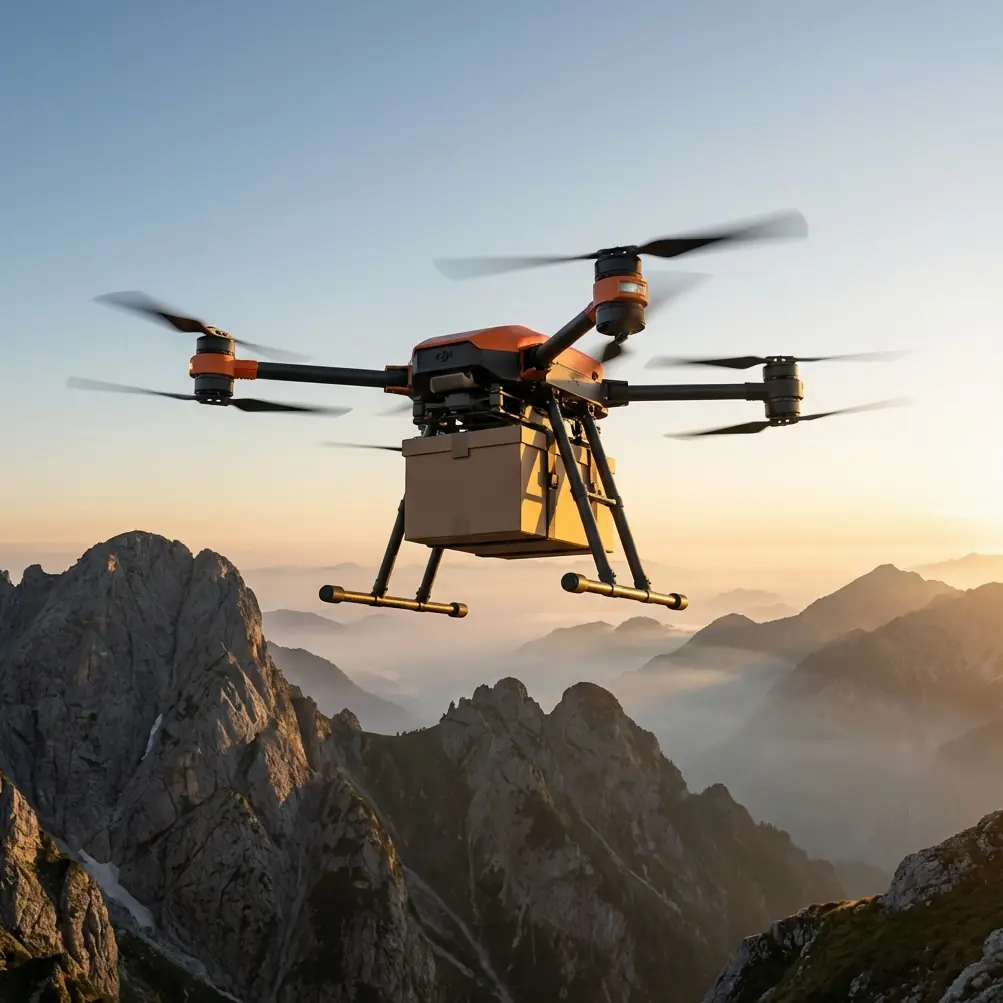
FlyCart 30 in Medical Logistics: What “Air Life Corridor” Demands From a Heavy-Lift UAV
META: A technical review of how FlyCart 30 fits medical drone logistics, from payload planning and BVLOS route design to winch delivery, dual-battery resilience, and EMI handling near urban infrastructure.
When people talk about drone delivery, they often drift into abstractions. Efficiency. Innovation. Smart cities. None of that means much when the payload is blood, temperature-sensitive medicine, a lab sample, or a defibrillator that needs to arrive before a ground vehicle can clear traffic.
That is why China’s push to build an “air life corridor” for medical emergency response deserves closer attention. The idea is straightforward but operationally demanding: use drones to move critical medical supplies through congested urban areas and difficult terrain fast enough to materially improve response times. The reference facts are simple on paper. Drones can transport blood, drugs, diagnostic samples, and emergency equipment. Compared with ground transport, they can reduce delivery time in complex terrain or traffic-heavy environments. And this sits inside a broader effort to strengthen smart healthcare and emergency rescue systems.
For anyone evaluating the FlyCart 30, that context matters more than a generic feature sheet. A medical logistics mission exposes every real capability and every weak link in a cargo platform. Payload ratio is no longer a marketing talking point. Route optimization stops being theoretical. A winch system is not just convenient; it can define whether delivery is even possible at a hospital entrance, clinic roof, or crowded transfer point. Safety layers such as an emergency parachute and dual-battery architecture become operational requirements, not optional reassurance.
This is where the FlyCart 30 becomes worth discussing seriously.
Medical logistics is a harder test than most cargo missions
A heavy-lift drone can carry tools, parts, or agricultural inputs without facing the same urgency profile as healthcare transport. Medical missions are less forgiving. The value of the aircraft is measured not only by what it can lift, but by whether it can preserve a reliable transport chain under urban constraints.
The Chinese “air life corridor” model highlights exactly those constraints. First, the cargo mix is varied. Blood products and medicines are very different from inspection equipment or field supplies. A platform must handle payload diversity while keeping the aircraft stable and routes predictable. Second, delivery points are often imperfect. Not every hospital or emergency site has a clean landing zone. Third, cities create signal clutter, wind tunnels between structures, and electromagnetic interference from dense infrastructure.
A drone used for this kind of work has to do more than fly from A to B. It has to fit into a system. That is the lens through which FlyCart 30 should be judged.
Why FlyCart 30’s payload strategy matters here
In emergency medical delivery, payload ratio affects more than total carrying capacity. It shapes route viability, battery planning, weather tolerance, and whether the operator can package cargo in a way that protects the contents.
That matters because medical payloads are not always heavy, but they are often operationally awkward. Blood transport may require controlled packaging. Diagnostic samples may need secure containment. Emergency equipment can be bulkier than its weight suggests. A platform with a strong cargo design gives logistics teams flexibility to carry what the mission actually requires rather than what the airframe happens to tolerate.
For FlyCart 30 operators, the payload question should be framed this way: can the aircraft lift enough to combine urgent items into one sortie without compromising reserve margins? In an “air life corridor” scenario, combining missions intelligently can make the difference between a useful network and a fragmented one. If one flight can move medicine, a sample return, and a lightweight emergency device in a single optimized trip, the system becomes more efficient and easier to scale.
That is where payload ratio becomes strategically significant. It is not just about lifting more. It is about preserving performance while carrying a medically relevant load.
The winch system is more than a convenience
One of the most practical features for urban medical logistics is the winch system. On many real delivery routes, landing is the least efficient part of the mission, and sometimes the least safe. Rooftops may be crowded. Ambulance bays may be active. Temporary emergency sites may lack a secure touchdown area.
A winch allows the aircraft to hover and lower cargo without forcing a landing. That sounds simple, but in medical response it changes the geometry of delivery. It can reduce ground disruption, shorten handoff time, and let operators use small or obstructed receiving areas. In dense city districts, that flexibility can determine whether a route is operational at all.
The significance grows in the exact environments highlighted by the reference material: congested settings and complex terrain. If drones are being adopted because roads are slow or terrain is restrictive, then the delivery endpoint itself is likely to be constrained too. A winch-equipped heavy-lift platform aligns naturally with that reality.
For hospitals, labs, and emergency coordinators, this creates a practical workflow advantage. The aircraft does not need a perfect landing pad every time. It needs a safe standoff point and a controlled lowering procedure.
BVLOS is where the medical use case becomes real
A local demo flight is easy. A functioning medical logistics corridor is not. To make drones genuinely useful for emergency transport across urban networks, operators eventually need BVLOS-style route structures, whether under pilot projects, managed corridors, or approved operational frameworks.
That is because healthcare transport value appears at network scale. A hospital campus to nearby clinic route may be helpful, but blood, medicine, and sample transport becomes transformative when multiple facilities can be connected consistently. The Chinese push described in the source is not about isolated flights. It is about improving emergency response efficiency across the system.
For FlyCart 30, this means route optimization is central. Medical drone routes should not simply trace the shortest line on a map. They need to account for obstacles, urban RF noise, weather corridors, alternate drop locations, battery reserves, and priority sequencing. A route that looks fast on paper but requires repeated manual intervention is not suitable for time-critical medical operations.
The best way to evaluate FlyCart 30 in this setting is to ask whether its mission profile supports repeatability. Can the aircraft hold stable behavior over a preplanned corridor? Can it support predictable cargo handling at both ends? Can operators build enough confidence into the route to make it part of an emergency workflow rather than a one-off trial?
Those are the real criteria.
Handling electromagnetic interference near urban infrastructure
The supplied context mentions a specific operational spark: handling electromagnetic interference with antenna adjustment. That detail is not decorative. It is one of the most realistic technical issues in urban cargo operations, especially around dense infrastructure.
If the reader scenario involves capturing solar farms in urban settings, EMI awareness becomes even more relevant. Large electrical installations, inverters, transmission-adjacent structures, rooftop power systems, and metallic support grids can create conditions that complicate command, telemetry, or positioning confidence. Add nearby buildings and communications infrastructure, and the RF environment becomes busy quickly.
In practice, antenna adjustment is one of those small details that separates smooth operations from unstable ones. Proper antenna orientation and placement can improve link quality, reduce dead zones during approach, and stabilize control performance when the aircraft transitions around reflective or obstructed surfaces. On FlyCart 30 missions, especially where cargo is suspended or lowered by winch, maintaining a clean, resilient link is not optional. The aircraft may be technically capable of the route, but degraded signal handling can turn a valid plan into an unreliable one.
This has direct relevance to medical delivery. If the point of the drone is to beat road congestion and shorten delivery time, then communications resilience becomes part of the response-time equation. A route delayed by signal uncertainty loses the advantage the aircraft was supposed to create.
When we train teams for urban logistics work, antenna setup is one of the first habits I insist on standardizing. Not because it is glamorous, but because preventable EMI-related issues often start there. If you are assessing route feasibility for FlyCart 30 in a dense built environment, get this detail right early.
Dual-battery architecture changes the risk profile
Medical flights are judged differently from routine commercial sorties because the tolerance for interruption is lower. That is where dual-battery design becomes meaningful. A heavy-lift UAV carrying urgent healthcare cargo benefits from power redundancy not only for endurance logic but for operational confidence.
A dual-battery setup helps logistics teams think in terms of resilience rather than minimum viability. It supports more disciplined reserve planning. It can also reduce pressure on dispatch decisions, because operators are not constantly trading route ambition against narrow energy margins.
This matters in the “air life corridor” concept because the mission set includes emergency supplies that may need to move despite traffic spikes, terrain barriers, or time-sensitive hospital demand. The aircraft has to be trusted not just by pilots, but by dispatchers, clinicians, and administrators. Redundancy contributes to that trust.
Emergency parachute thinking belongs in healthcare aviation
Cargo UAVs working over urban and peri-urban areas need layered safety, full stop. In medical logistics, an emergency parachute should be viewed as part of the airworthiness conversation around public acceptance and operational continuity.
The public will tolerate medical drone networks only if safety systems are visible, credible, and integrated into procedure. Hospitals and municipal stakeholders are the same. They do not just need an aircraft that can move cargo. They need one that can fit inside a defensible risk framework.
That is one reason the Chinese medical drone story is bigger than drone delivery alone. It is tied to smart healthcare and emergency rescue infrastructure. Once drones become part of that larger system, every flight is no longer just an aviation event. It is a service event. Safety features such as an emergency parachute support the legitimacy of that service model.
What this means for urban solar farm operators too
At first glance, medical transport and urban solar farm operations seem unrelated. They are not. The overlap is operational discipline.
If you are using or evaluating FlyCart 30 around urban solar assets, you are dealing with some of the same constraints that define medical logistics: restricted access, infrastructure-dense environments, EMI exposure, complex approach paths, and pressure to complete missions efficiently. In one case the payload may be imaging support gear, maintenance components, or inspection tools. In another, it is blood or medicine. The airspace and systems problem is surprisingly similar.
That is why the “air life corridor” model is such a useful benchmark. It forces us to evaluate FlyCart 30 under conditions where time, route reliability, and controlled delivery all matter at once. If the aircraft can perform inside that framework, it says something meaningful about its value in other urban industrial workflows.
My verdict as a logistics lead
FlyCart 30 makes the most sense when you stop treating it as a generic cargo drone and start viewing it as a node in a mission-critical network. The Chinese medical emergency use case shows exactly why. Drones are being used to carry blood, drugs, test samples, and emergency equipment because they can cut delivery time when roads are slow or terrain gets in the way. That is not a hypothetical advantage. It is a systems-level argument for aerial logistics.
Under that kind of pressure, the right questions become obvious. Does the payload configuration support medically relevant loads without eroding mission reserves? Can the winch system handle constrained delivery points? Is BVLOS route planning mature enough to support repeat operations? Are antenna adjustments and RF discipline being treated as serious EMI countermeasures in urban infrastructure zones? Do dual-battery and emergency parachute systems support a safety case that hospitals and city stakeholders can accept?
Those are the questions FlyCart 30 should answer.
If you are modeling routes, payload workflows, or EMI-sensitive delivery corridors for this platform, a practical discussion often helps more than another brochure. You can reach out here for route and mission planning notes: message our operations desk.
The larger takeaway is simple. The real promise of FlyCart 30 is not that it can carry cargo. Many aircraft can do that. Its value appears when the cargo is urgent, the destination is awkward, the airspace is cluttered, and the system still has to work.
That is the standard set by an airborne medical corridor. And it is the right standard for judging any serious logistics drone.
Ready for your own FlyCart 30? Contact our team for expert consultation.