
What Amazon’s 30-Minute Drone Delivery Teaches Urban
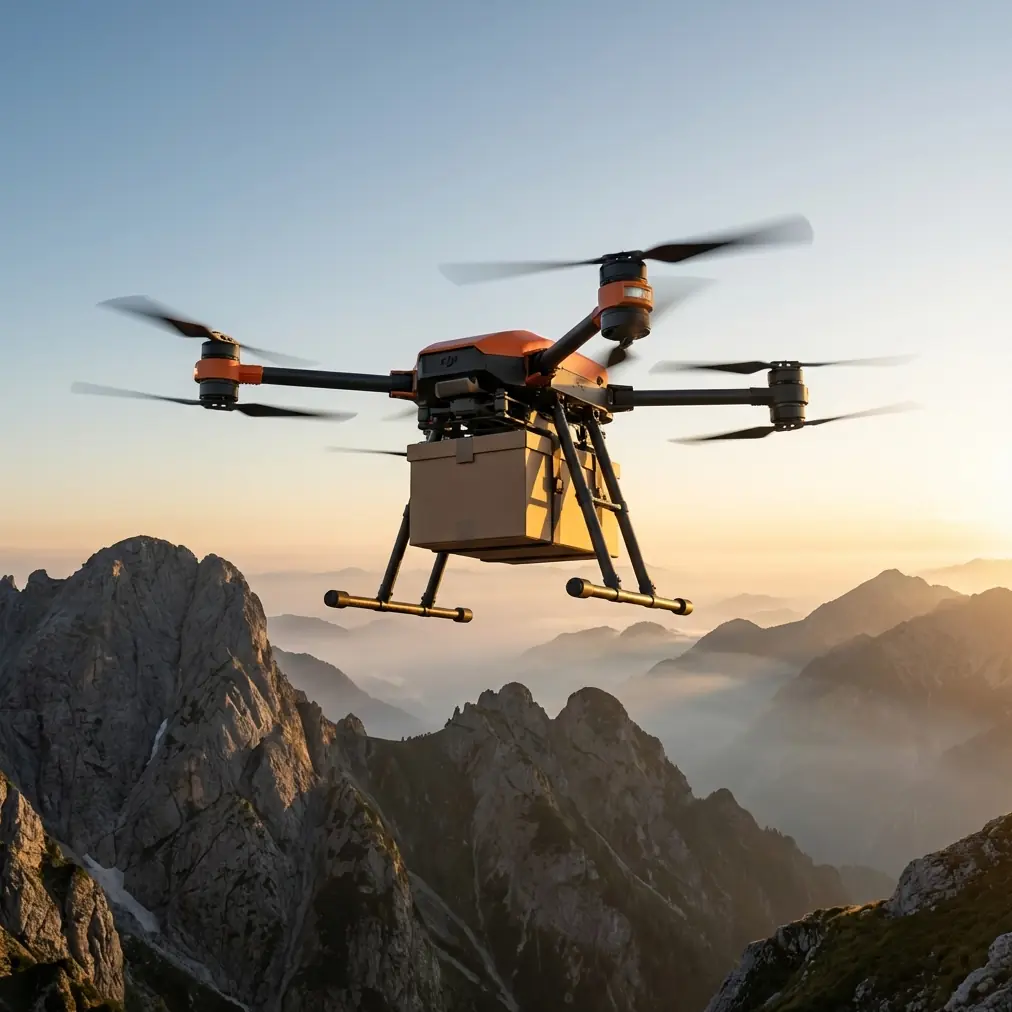
What Amazon’s 30-Minute Drone Delivery Teaches Urban Construction Teams Using FlyCart 30
META: A practical FlyCart 30 case study for urban construction logistics, using Amazon’s 30-minute drone delivery benchmark to explain payload fit, route limits, safety layers, and real-world site operations.
When people talk about delivery drones, they usually jump straight to spectacle. Fast parcels. Autonomous flights. Futuristic headlines.
That misses the real question.
For operators responsible for moving materials into dense urban job sites, the issue is not whether a drone can look impressive on a demo day. It is whether the aircraft can turn a messy, delay-prone supply problem into a repeatable workflow. That is where the FlyCart 30 becomes worth discussing seriously.
I’ve spent enough time around construction logistics to know that city projects rarely fail because of one dramatic problem. They get slowed down by accumulation: blocked access roads, crane scheduling conflicts, missing tools, one forgotten component that holds up a trade crew for half a shift. In that environment, drone transport is not about replacing every truck. It is about solving the last hard segment between storage, staging, and point of use.
A useful way to frame the FlyCart 30 is to compare the broader delivery drone promise with what real operations demand. One reference point stands out. Amazon said it was testing small unmanned aircraft aimed at delivering small packages within 30 minutes of ordering, serving customers within a 16-kilometer radius of a warehouse. It also said those aircraft were suited to parcels around 2.27 kilograms, a weight band representing about 86% of its existing parcel volume.
Those numbers matter, especially for construction teams.
They show that drone logistics becomes commercially interesting when two things line up at the same time: a high percentage of missions fall within a workable payload band, and the service area is tight enough to support fast turnarounds. Amazon’s concept was built around consumer parcel density. Urban construction teams can apply the same logic, but with a different mission profile.
The Construction Version of the 86% Rule
On a building site, not every load belongs on a drone. That should be obvious. Rebar bundles, large glazing units, and palletized materials stay with conventional lifting and ground transport. The gains appear when you study the site’s “small but urgent” category.
Think about what repeatedly stalls progress:
- fastening systems
- electrical components
- survey gear
- inspection tools
- replacement batteries
- sealants and specialty consumables
- documentation kits
- compact mechanical parts
- emergency PPE replenishment
This is where the payload ratio concept becomes useful. Amazon highlighted that 2.27-kilogram parcels represented 86% of its package flow because that ratio justified system design. Construction managers should perform the same exercise with internal site movement data. Once you identify what percentage of urgent transfers fit drone delivery profiles, you stop treating UAV transport as novelty and start sizing it like infrastructure.
That is exactly how I would position the FlyCart 30 on an urban project. Not as a flying warehouse. As a precision logistics layer for the category of items that are light enough, time-sensitive enough, and disruptive enough when late.
Why the 16-Kilometer Radius Is a Better Lesson Than the 30-Minute Headline
The eye-catching part of Amazon’s concept was 30-minute delivery. The more operationally useful detail was the 16-kilometer service radius.
In urban construction, route planning always beats raw speed. A drone can only create value if the origin, destination, launch windows, and airspace constraints form a practical loop. Shorter legs do more than reduce transit time. They improve battery planning, increase mission frequency, simplify contingency procedures, and make return-to-base logic more reliable.
That is where FlyCart 30 planning becomes disciplined rather than aspirational.
On a city project, you are rarely just flying from point A to point B in empty air. You are working around tower cranes, partially enclosed structures, temporary site offices, changing façade geometry, delivery schedules, and radio-frequency clutter. Route optimization matters because every unnecessary detour consumes time and energy that should have been reserved for safety margin.
This is why I push teams to think in service cells, not map-wide freedom. If your laydown yard, rooftop staging zone, nearby consolidation point, and active workface can be linked through repeatable corridors, the aircraft becomes part of the site system. If every mission feels custom, the drone remains an experiment.
Amazon’s radius figure tells us something simple but overlooked: drone logistics works best when the network is intentionally bounded.
FlyCart 30 in an Urban Job-Site Case Study
Let me put this into a realistic scenario.
A high-rise mixed-use project is moving into MEP and façade coordination phases. Street access is constrained. Deliveries are restricted to narrow windows. The tower crane schedule is fully loaded, and minor material requests are constantly competing with larger lift priorities.
The site team deploys FlyCart 30 to connect three zones:
- an off-street logistics hub
- a rooftop or mid-level controlled receiving zone
- selected internal handoff points for urgent small-load transfers
At first glance, this sounds straightforward. It is not. Success depends on the details.
The first challenge is payload fit. The team audits six weeks of urgent requests and finds that a large share of delay-causing movements are not heavy. They are compact and time-critical. That mirrors the significance of Amazon’s 86% observation, even though the actual payload categories differ. The point is not the exact weight. The point is identifying a dominant mission class that the aircraft can absorb efficiently.
The second challenge is vertical delivery. This is where the winch system changes the equation. On urban sites, landing is often the worst option. Space is limited, surfaces are cluttered, and people and equipment are constantly moving. A controlled winch drop into a secured receiving area reduces the need for touchdown zones and allows the aircraft to remain clear of obstacles while the payload is lowered precisely. For construction, that is not a luxury feature. It is often the difference between a workable operation and a rejected one.
The third challenge is continuity. Construction schedules do not care that your battery strategy was an afterthought. A dual-battery configuration matters because it supports predictable mission cycling and adds resilience to repeated short-haul operations. In practical terms, that means less downtime between flights and more confidence in maintaining service during busy windows.
The Safety Layer That Makes Stakeholders Say Yes
Amazon’s public drone plan also came with a cautionary note: real-world deployment faced legal, technical, safety, and social barriers. That remains true across commercial UAV logistics today, and construction teams ignore that at their own expense.
Urban projects bring additional scrutiny because flights happen near workers, adjacent properties, and active infrastructure. Stakeholder acceptance depends less on marketing claims and more on visible safeguards.
For FlyCart 30 operations, three elements tend to matter most in boardroom and site briefings:
1. Emergency parachute
This is not just a checkbox for presentations. It is a risk-control measure that affects whether site leadership, insurers, and safety officers are willing to approve routine flights over or near operational areas. If an aircraft is part of daily logistics, emergency descent mitigation becomes part of the trust framework.
2. Obstacle-aware route discipline
Amazon’s concept referenced navigation that could avoid buildings, wires, and other obstacles. In urban construction, that principle is non-negotiable. Routes must account for permanent structures and temporary conditions, because a site changes week by week. Good planning includes not only the route itself but also update procedures as cranes swing, scaffold rises, and access points move.
3. BVLOS readiness in the broader roadmap
Even if a project begins with tightly controlled operations, long-term scaling often depends on BVLOS-capable planning and regulatory alignment. For multi-building campuses, infrastructure corridors, or distributed urban projects, the ability to extend beyond close visual operations can redefine labor allocation and dispatch efficiency. It should be treated as a future operating model, not an abstract acronym.
Why the Winch System Is More Than a Feature
I want to stay on the winch for a moment because it is one of the most practical differentiators in construction use.
A drone that requires a clean landing zone asks the site to reorganize itself around the aircraft. A drone with a capable winch can adapt to the site instead.
That distinction has consequences.
It reduces interference with ground crews. It helps keep rotors farther from clutter and personnel. It can shorten receiving time when managed by a trained handoff team. It also opens delivery possibilities to elevated or partially enclosed areas that would otherwise be inaccessible without additional lifting support.
On one urban workflow, a third-party landing and cargo guidance accessory made a surprising difference. The team added a high-visibility suspended load stabilizer and receiver marker package to improve payload alignment in turbulent air near the building edge. That accessory did not change the aircraft’s core capability, but it improved handoff consistency enough to reduce aborted attempts during windy periods. This is a good reminder that capability growth often comes from the ecosystem around the platform, not only the airframe itself.
What Construction Leaders Should Measure Before Scaling
Too many drone programs get judged on flight success alone. That is shallow thinking. A site should measure whether FlyCart 30 improves the logistics system around the flight.
The right metrics usually include:
- average delay avoided per urgent transfer
- payload fit rate across repeated requests
- mission turnaround time by route
- reduction in crane interference for small loads
- number of truck or van trips eliminated within the local zone
- handoff accuracy using winch delivery
- weather-related interruption rate
- battery swap efficiency and sortie cadence
This is where the Amazon comparison becomes useful again. The promise of 30-minute fulfillment made sense because the company was thinking in system metrics, not just aircraft capability. Construction teams should do the same. The question is not “Can FlyCart 30 carry this item?” The better question is “Does this mission remove friction from the project at a rate that justifies operational integration?”
The Limits Matter Too
A serious article on FlyCart 30 should be honest about this: drone logistics is not a magic answer for every urban construction constraint.
There are still regulatory approvals, flight planning burdens, weather impacts, site-specific hazards, and public perception issues. There are training requirements for crew coordination. There are days when a conventional courier remains the simpler option. Amazon’s own drone effort was framed by delays tied to law, technology, safety, and social acceptance. That should temper unrealistic expectations in construction as well.
But realism is not pessimism.
It simply means the strongest use cases are the ones that are narrowly defined, repeatedly needed, and operationally expensive to solve with conventional methods. When that pattern exists, FlyCart 30 starts to look less like a future idea and more like a practical site asset.
My View as a Logistics Lead
If I were advising an urban construction team evaluating FlyCart 30 today, I would not start with broad transformation language. I would start with a route map, an urgency log, and a payload audit.
I would identify the recurring material movements that regularly disrupt labor productivity. I would test whether those missions cluster within a manageable urban radius, just as Amazon’s 16-kilometer planning boundary reflected the importance of geographic discipline. I would compare the number of urgent requests that fit the drone workflow, much like the logic behind the 2.27-kilogram parcel category representing 86% of one retailer’s delivery volume.
Then I would build the operation around safety and repeatability: winch-based delivery where landing is impractical, dual-battery rotation to sustain sortie tempo, emergency parachute provisions to support approval confidence, and route optimization tied to weekly site changes.
That is how a drone becomes useful on a job site. Not because it flies. Because it fits.
If your team is mapping an urban construction delivery workflow and wants to discuss route design or accessory choices, you can message a UAV logistics specialist here and compare notes against your site constraints.
The bigger lesson from headline drone delivery projects is not that speed sells. It is that fit determines adoption. A 30-minute promise sounds exciting, but the operational backbone is payload distribution, radius discipline, navigation reliability, and risk control. Those same pillars apply to FlyCart 30 on construction sites, only the value is measured in avoided downtime, cleaner handoffs, and fewer interruptions to crews already working on tight margins.
That is the real story.
Ready for your own FlyCart 30? Contact our team for expert consultation.