
FlyCart 30 in the Mountains: What Real Drone Delivery
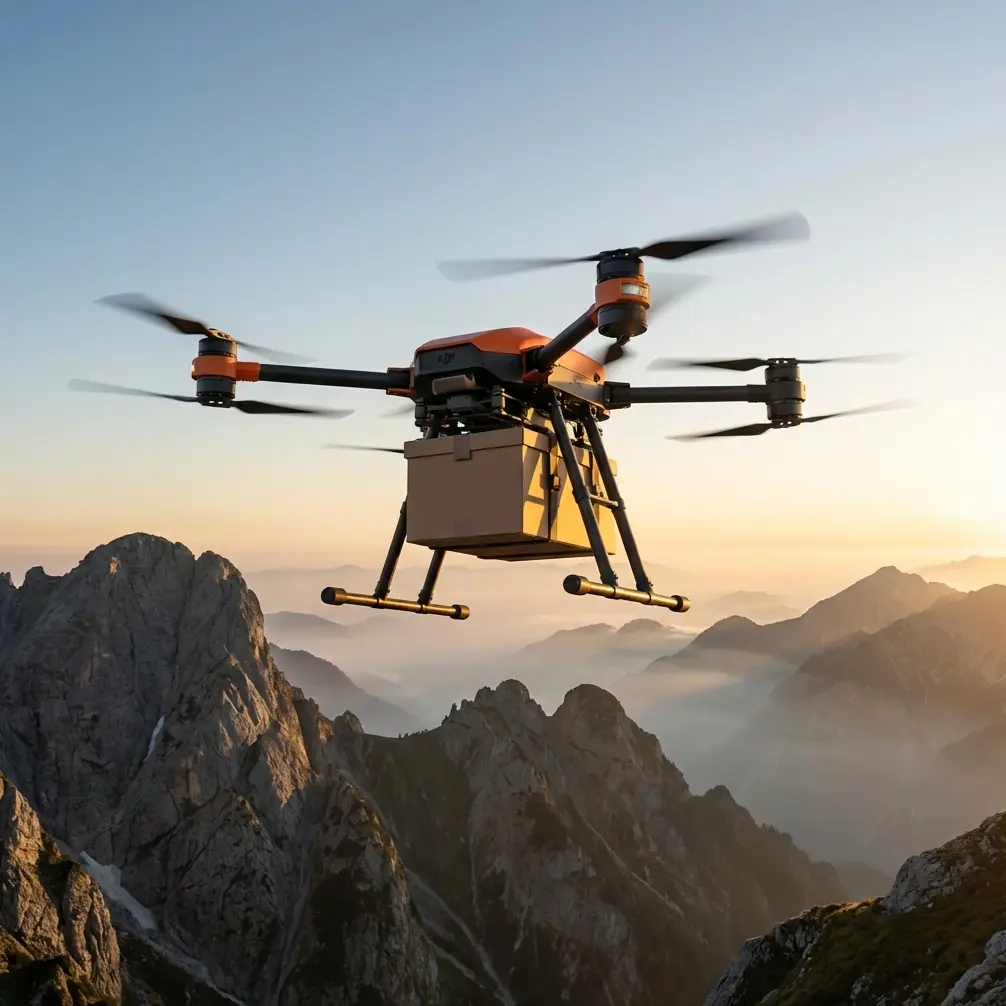
FlyCart 30 in the Mountains: What Real Drone Delivery Networks Teach Us About Power Line Logistics
META: A field-grounded look at how FlyCart 30 fits mountain power line delivery, using lessons from real drone delivery network expansion in healthcare, retail, and enterprise logistics.
When people talk about delivery drones, they usually picture small packages moving between suburban rooftops and distribution hubs. That image misses where aerial logistics can become genuinely useful: difficult terrain, narrow access roads, unstable weather windows, and jobs where every extra trip costs time, labor, and risk.
That is exactly why the FlyCart 30 deserves attention in mountain power line work.
I’m looking at this from a logistics lead’s perspective, not as a hobbyist fascinated by aircraft specs in isolation. If your task is delivering tools, insulators, rope, or line components up a mountainside to support power line construction or repair, the aircraft only matters if it improves the whole operation. Payload ratio matters. Route planning matters. Recovery margin matters. And perhaps most of all, whether the drone can be folded into a real deployment model instead of becoming another pilot project that looks good in a demo and stalls in the field.
That last point is where recent industry movement becomes relevant.
A newly announced partnership between Matternet and SoftBank Robotics America is centered on scaling drone delivery networks across healthcare, retail, and enterprise logistics. The language around that move matters. The emphasis is not on experimentation for its own sake. It is on accelerating autonomous aerial delivery systems and pushing toward real-world deployment, not pilot-only programs. Even though FlyCart 30 serves a different mission profile than a lightweight medical courier drone, the signal from the market is unmistakable: commercial drone logistics is being judged less by novelty and more by whether it can operate as infrastructure.
For mountain power line delivery, that shift changes the standard.
The mountain problem is not distance alone
On paper, moving materials up a slope may not look dramatic. A work site can be a short linear distance from a road staging area and still be painfully expensive to serve. Terrain bends routes. Switchback access roads stretch travel time. Mud, loose rock, and snow can turn a ten-minute ground move into an hour of repositioning. Then there is the payload issue. Crews rarely need just one item. They need a repeatable way to move awkward, often urgent loads without tying up the entire team.
This is where a cargo platform like FlyCart 30 enters the conversation. Not because it replaces every truck or every human porter, but because it can remove the most inefficient segment of the mission: the final vertical or near-vertical lift into hard-to-reach work zones.
In mountain power line work, that segment is often the one that carries the highest friction. You may have road access to a lower camp, but not to the tower foundation or repair point above. You may have a safe place to stage gear, but not a practical path to carry it over ravines, through brush, or across unstable slopes. Traditional lifting methods can involve more personnel, more exposure, and more waiting for the exact right conditions.
A drone with a serious payload strategy and a winch system changes how the job is sequenced. Instead of forcing a landing on uneven terrain, the aircraft can deliver from a controlled hover and lower the load into a workable drop zone. In mountain settings, that operational detail is not a convenience. It is often the difference between a viable mission and a canceled one.
What “real-world deployment” means for FlyCart 30 operators
The Matternet-SoftBank Robotics America partnership is focused on healthcare, retail, and enterprise logistics. At first glance, that may seem far removed from utility support in the mountains. It is not.
Healthcare networks care about reliability because timing affects patient care. Retail networks care about scalability because one route means nothing if it cannot be repeated across many routes. Enterprise logistics cares about integration because delivery only has value if it fits larger workflows. Those same pressures exist in mountain power line logistics, just under different labels.
- Reliability becomes mission completion under changing weather and terrain.
- Scalability becomes the ability to run repeated lifts across multiple towers or work sites in a day.
- Integration becomes fitting drone delivery into crew planning, staging, battery rotation, and route authorization.
That is why the strongest takeaway from the partnership is not brand-specific. It is structural. The drone sector is moving away from isolated trial flights and toward repeatable network logic. For FlyCart 30 users, that means the conversation should not stop at “Can this aircraft carry the load?” The better question is “Can we build a mountain delivery workflow around it that crews trust after the fifth, fiftieth, and five-hundredth sortie?”
That is the threshold between technology adoption and operational dependence.
Payload ratio is not just a specification
Anyone evaluating FlyCart 30 for mountain utility work should look carefully at payload ratio. Not because bigger numbers automatically win, but because payload efficiency determines whether the sortie saves labor in practice.
A heavy-lift platform that burns too much operational time for too little useful cargo can become a drain. A better-balanced aircraft improves logistics math. If one flight can move the right item at the right moment without forcing extra landing complexity, the drone starts doing what all good logistics tools do: it compresses the delay between need and delivery.
Power line crews in mountain terrain do not simply need lifting capacity. They need useful lifting capacity. There is a difference. A spool line, hardware kit, anchor component, or repair tool set is valuable because it prevents downtime up the slope. A drone mission earns its keep when it shortens that downtime.
That is why route optimization deserves as much attention as raw carrying ability. In a mountain corridor, the shortest route is rarely the best route. You may need to avoid ridgeline turbulence, maintain safer obstacle clearances, preserve battery reserve for descent, or choose an approach angle that keeps the suspended load stable. A well-planned route can turn a marginal mission into a routine one.
The winch system is where mountain operations get practical
The most underrated detail in cargo drone discussions is often the load delivery method. For mountain power line work, the winch system is not an accessory feature. It is central.
Landing a cargo drone on a rough alpine bench or improvised work pad introduces unnecessary complexity. Surface slope, rotor wash, vegetation, and loose debris all work against a clean touchdown. Hover delivery with a winch avoids many of those variables. It allows the pilot or mission supervisor to keep the aircraft in a more controlled air position while lowering the load into a smaller, more predictable handoff area.
Operationally, that means less time searching for landing zones and less pressure to modify the work site around the aircraft. The site can stay focused on the line task itself.
I have seen teams underestimate how much this matters until they are halfway through a mountain job. The first few lifts seem straightforward, then a cloud bank rolls through, a slope-side landing area gets gusty, and suddenly the mission profile changes. A winch system gives the operation more tolerance. It creates options.
On one survey-linked supply run near a wooded transmission corridor, a drone’s sensors had to work around a golden eagle crossing the route line just below a ridge. That kind of encounter is not theoretical in mountain environments. It is exactly why obstacle awareness and route discipline matter. A capable cargo workflow is not just about moving material. It is about doing so with enough sensing and mission control to adapt safely to the actual environment, including wildlife movement that can appear with no warning.
BVLOS matters when the mountain eats your line of sight
In mountain delivery, line of sight can disappear quickly. A ridge shoulder, tree stand, or elevation shift can block visual continuity even when the aircraft is still on a sensible route. That is why BVLOS capability enters the conversation early for serious operators.
Not every mountain mission requires BVLOS, and regulatory requirements remain decisive. Still, the relevance is obvious. Utility corridors often extend beyond direct visual observation from a single staging point. If your objective is to support multiple towers or repeated runs along a mountain alignment, route architecture and operational approvals become as important as the aircraft platform itself.
This again connects back to the broader industry signal from Matternet and SoftBank Robotics America. Their partnership is about expanding networks, not proving one-off flights. Networks imply route governance, mission repeatability, dispatch logic, and operational confidence. FlyCart 30 teams serving power line work should think in the same terms. The future winner in mountain cargo operations will not be the operator with the most dramatic single lift. It will be the operator who can run dependable aerial supply lanes that crews can schedule around.
Dual-battery thinking is really continuity planning
Mountain jobs punish weak energy planning. If you are rotating batteries inefficiently, your aircraft may spend too much of the workday grounded while the crew waits for the next load. A dual-battery architecture matters because it contributes to continuity. It supports safer reserve management and can help stabilize operational tempo across repeated sorties.
That tempo is what crews feel. They do not care whether the airframe looked impressive on a spec sheet if the lift rhythm breaks down by midday. They care that critical gear reaches the work point when needed, and that the delivery cadence is predictable enough to plan labor around.
In my view, this is one reason the enterprise logistics angle in the Matternet news deserves attention. Enterprise users adopt aerial systems when they improve continuity inside a larger process. Mountain power line support is no different. Drone delivery is not a spectacle. It is a supply chain link, and supply chain links are judged by consistency.
Safety systems are not abstract in the mountains
Emergency parachute capability sounds like one of those features people mention quickly and then move past. In mountain operations, it deserves a harder look.
The terrain below the aircraft may include forest, ravine edges, rocky shelves, and work crews spread across elevation bands. A cargo mission over that environment needs layered risk control. An emergency parachute does not eliminate operational risk, but it adds a recovery measure that can matter when conditions turn or a fault occurs in a difficult location.
The practical value is psychological as well as technical. Teams are more willing to integrate a drone into routine logistics when the system shows visible respect for failure management, not just success performance.
That is another hallmark of the industry’s move from pilot programs to deployment at scale. Serious operations are designed around exception handling. What happens if a route is blocked? What happens if weather shifts? What happens if the aircraft cannot continue the mission? Mature drone logistics programs answer those questions before takeoff.
FlyCart 30 fits best when treated as part of a network, not a hero tool
This is the central point. A mountain power line team will get the most from FlyCart 30 when the drone is embedded in a workflow:
- staged cargo preparation at the base area
- route optimization by terrain and wind pattern
- battery rotation planning
- winch-based handoff procedures at the upper work zone
- contingency rules for visibility, wildlife, and weather
- documentation that supports repeatable flights over time
That is what real deployment looks like.
The latest delivery-network partnership in the drone sector reinforces the same lesson from a different corner of the market. Whether the payload is a medical item in healthcare, a package in retail, or equipment for enterprise logistics, the successful model is shifting toward systems that can be scaled and trusted. Not showcase missions. Not isolated wins. Real operations.
For mountain power line delivery, FlyCart 30 becomes valuable when it reduces carry burden, shortens downtime, limits unnecessary exposure on steep ground, and supports repeatable logistics to difficult sites. If you are planning that kind of workflow and want a field conversation around route design, payload handling, and deployment setup, you can message our logistics team here.
The drone industry is finally maturing past the stage where a successful test flight is treated as the finish line. The current direction, underscored by the Matternet and SoftBank Robotics America partnership announced on 2026-04-17, is toward scaled aerial logistics in healthcare, retail, and enterprise environments. That matters to anyone evaluating FlyCart 30 for mountain utility operations because it confirms where the standard now sits: operational repeatability, not novelty.
In steep terrain, that standard is overdue. Mountain line work has always needed better ways to move material uphill without wasting manpower or exposing crews to unnecessary strain. FlyCart 30 is compelling not because it makes the mountains easy, but because it can make the hardest leg of the job far more manageable when paired with disciplined route planning, a practical winch workflow, resilient battery operations, and the right safety logic.
That is what separates a useful cargo drone from a field toy.
Ready for your own FlyCart 30? Contact our team for expert consultation.