
FlyCart 30 in Mountain Solar Logistics: What a New Chinese
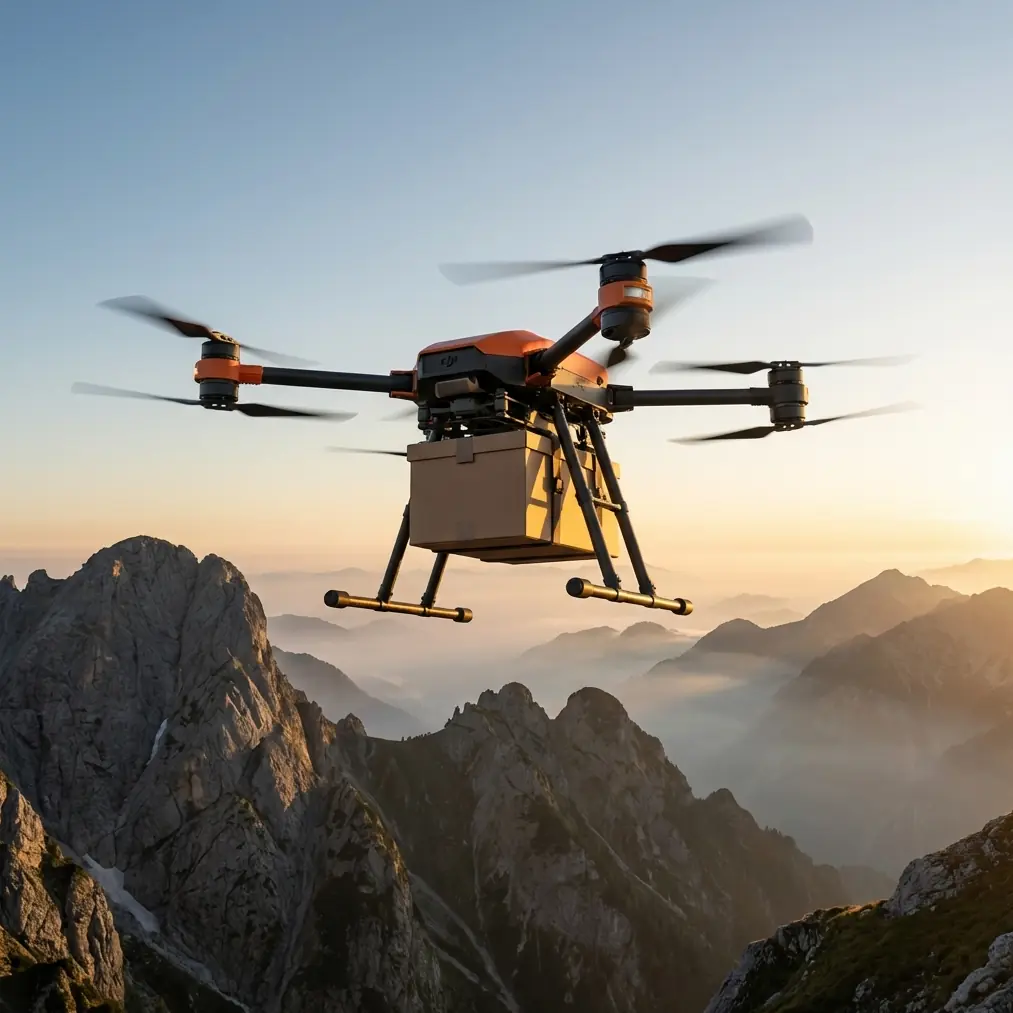
FlyCart 30 in Mountain Solar Logistics: What a New Chinese Type Certificate Tells Us About Real-World Drone Delivery
META: A field-led technical review of FlyCart 30 for mountain solar farm delivery, with lessons from China’s latest airworthiness milestone, battery management, route planning, payload ratio, winch use, and BVLOS-ready operations.
Mountain solar projects expose every weakness in a logistics plan. Roads are narrow or unfinished. Elevation changes drain vehicle time. Weather shifts by the hour. The “last mile” often becomes the most expensive 800 meters of the whole build.
That is exactly where the FlyCart 30 starts to make operational sense.
I’ve worked on job sites where a crate of connectors, inverter parts, fasteners, or a replacement sensor can stall a team for half a day simply because ground access is bad. On paper, drone delivery looks like a straightforward fix. In practice, it only works when the aircraft, route design, power strategy, and safety case are aligned with the terrain. That’s why a recent certification development in China matters, even if your immediate interest is the FlyCart 30 rather than another platform.
A recent report from CAAC News stated that the E40H civil unmanned aircraft system received a type certificate on 2025-12-30 from the Civil Aviation Administration of China’s Central South Regional Administration, under certificate number TC0105A-ZN. The operational significance is bigger than the product itself. According to the report, the E40H is the world’s first medium-class compound-wing, hybrid-power unmanned aircraft in its category to meet the authority’s airworthiness requirements and secure that approval. The same report also says that, so far, 19 civil unmanned aircraft models from 10 Chinese companies have received type certificates, with 9 of those from DJI.
Why should a mountain solar logistics team care?
Because certification trends tell you where the industry is heading: away from ad hoc “it flew once” demonstrations and toward repeatable, regulated, auditable drone transport. If you are evaluating FlyCart 30 for solar farm delivery in mountainous terrain, you are no longer just comparing payload figures. You are building a workflow that has to stand up to risk reviews, insurance questions, contractor coordination, and, increasingly, formal oversight.
The certification signal behind FlyCart 30 adoption
The E40H news is not about FlyCart 30 directly, but it reveals something useful. China’s unmanned sector is steadily moving into mission classes where design safety and airworthiness are central, especially in transport, emergency response, and agriculture. Transport is the key word here.
For years, drone cargo discussions were dominated by demos. Lift a box, cross a valley, land, take a photo. That phase is ending. Once regulators recognize a transport platform through a type certificate, they are effectively signaling that drone logistics can no longer be treated as a novelty. The design, redundancy, control logic, and operational envelope all come under harder scrutiny.
For FlyCart 30 operators, this changes the conversation inside commercial projects. A mountain solar developer is less likely to ask, “Can a delivery drone technically carry this?” and more likely to ask, “Can this become a dependable part of site logistics without introducing unacceptable operational uncertainty?”
That is a better question. And FlyCart 30 is best judged through that lens.
Why mountain solar sites are a strong use case for FlyCart 30
Solar farms in mountainous regions create a logistics profile that fits cargo UAV deployment unusually well:
- frequent movement of small but time-critical parts
- repeated transport along predictable corridors
- steep terrain that punishes ground vehicles
- elevated labor costs when crews sit idle waiting for material
- temporary work zones where fixed infrastructure is limited
This is where payload ratio matters more than headline payload alone.
A drone does not need to replace every truck run. It needs to remove the most disruptive trips. In field terms, that means carrying items whose transport time is out of proportion to their size. A modest load of electrical components, tools, cable accessories, inspection kits, or emergency replacement parts can rescue hours of labor on the installation front.
The strongest FlyCart 30 deployments I’ve seen are not the ones trying to do everything. They are the ones built around a disciplined cargo profile: what absolutely must move by air, how often, and under what weather and battery thresholds.
Payload ratio is where operators either gain efficiency or lose it
Many teams talk about maximum payload as if it is the only number that matters. On mountain solar projects, it is often the wrong metric to fixate on.
Payload ratio is the more useful field measure. By that I mean the relationship between what you are lifting and the energy, turnaround time, and operational complexity required to move it safely. A drone at the edge of its lifting capability may still be legal and technically capable, but the mission economics often deteriorate quickly in altitude, wind, and uneven approach conditions.
On a mountain site, a better-performing operation usually keeps margin in reserve. That reserve pays for itself in three ways:
- More stable handling in variable wind
- Better battery consistency across repeated flights
- Reduced mission disruption when the landing or drop zone is imperfect
If your crews are feeding a solar installation line, the objective is not a heroic single lift. It is a predictable sequence of deliveries that does not create bottlenecks. A conservative payload ratio supports that.
The winch system is not a convenience feature. It is a terrain tool.
For mountain solar farms, the winch system is one of the FlyCart 30’s most practical advantages.
A lot of upland sites do not offer clean landing zones near the receiving team. You may have slope instability, loose aggregate, temporary steel, panel stacks, or workers spread across narrow terraces. Landing a cargo drone every time can introduce unnecessary risk and waste time repositioning people.
A controlled suspended delivery solves several of those problems. The aircraft can remain clear of obstructions while the payload is lowered into a defined handoff point. That reduces downwash issues near loose materials and helps keep the aircraft away from unstable footing.
Operationally, the winch matters because it expands the number of usable delivery points without requiring every point to be landing-grade. On mountain sites, that is not a minor benefit. It is often the difference between a drone route that fits the project and one that remains a demo.
That said, winch operations demand discipline. Tag lines, receiving procedures, exclusion zones, and communication protocols all need to be standardized. The smoother your ground choreography, the more value the aircraft delivers.
BVLOS thinking starts long before a regulator signs off
People often talk about BVLOS as a checkbox. In the field, it is a planning culture.
Even if your current operation is constrained to visual line of sight or tightly managed corridors, mountain solar logistics benefits from BVLOS-style route design from day one. That means:
- fixed dispatch points
- mapped alternates
- terrain-aware route segmentation
- communication dead-zone analysis
- pre-defined abort logic
- weather triggers for suspension
This is another place where the E40H type certification news carries weight. When a platform receives type approval as an airworthy civil transport product, it reinforces the broader shift toward structured operations rather than improvisation. The future of commercial drone logistics will belong to teams that document and repeat procedures, not teams that rely on pilot instinct alone.
For FlyCart 30, that translates into route optimization that accounts for terrain shadows, ridge lift, valley funnel winds, and battery reserve policies. Solar sites in mountains may look geographically compact on a map, but the energy cost of each leg can vary sharply based on elevation profile and wind exposure.
My most useful battery management tip from the field
Here’s the battery lesson I wish more teams learned early: do not rotate batteries based only on charge percentage; rotate them based on thermal history and route difficulty.
On paper, two batteries at the same state of charge look interchangeable. On a mountain site, they often are not. One pair may have just completed a steep outbound leg with a near-limit payload and a hover-heavy winch drop in warm afternoon conditions. Another pair may have run a lighter route with cleaner airflow and shorter hover time. Treating those battery sets as equal is how performance drift creeps into the day.
My rule is simple. Log each battery pair by:
- mission weight class
- route elevation gain
- hover duration
- ambient temperature
- turnaround interval before reuse
Then assign the fresher thermal pair to the route with the highest uncertainty. Save the more stressed set for a lighter, shorter run if it still meets your reserve rules.
This matters even more in dual-battery systems, because redundancy is only as useful as the quality of the batteries you are depending on. A dual-battery architecture improves operational resilience, but it does not cancel the consequences of poor battery discipline. On mountain jobs, battery management is not just a maintenance topic. It is a route reliability topic.
Emergency parachute and layered safety thinking
Cargo UAV discussions can get stuck on lift and range. That is incomplete. For commercial deployment on active infrastructure projects, safety layers deserve equal weight.
An emergency parachute system, where supported within the platform and operation design, matters because mountain worksites are unforgiving environments. You have contractors, temporary staging zones, uneven topography, and changing wind behavior near cut slopes and ridgelines. If you are building a serious drone logistics program, passive and active risk controls should be part of the procurement and standard operating discussion from the start.
The broader lesson from the E40H type certificate is that design safety is no longer a soft talking point. The CAAC report specifically ties the certificate to meeting airworthiness and safety requirements. That is the operational significance: regulators are signaling that transport UAVs must be judged on system integrity, not just mission capability.
For FlyCart 30 operators, that should push attention toward redundancy, descent contingencies, geofencing logic, maintenance intervals, and crew training standards. Not because it sounds good in a proposal, but because mountain solar sites punish weak systems.
Route optimization on solar farms is mostly about cadence
When people hear route optimization, they often think software. Software helps, but the larger gain usually comes from aligning drone cadence with site workflow.
If your FlyCart 30 is serving a mountain solar project, ask these questions first:
- Which crews lose the most productive time waiting for parts?
- Which materials have small volume but high schedule impact?
- Which delivery points repeat daily?
- Where does terrain create the biggest delay by vehicle?
- What is the fastest practical cycle time with battery swaps included?
That last one matters. Many drone deployments fail because they are measured by flight novelty rather than by system throughput. If a route saves 20 minutes in travel but loses 15 minutes in poorly managed loading, battery handling, and receiving coordination, the gain is mostly gone.
The best operations create a rhythm: load, launch, transit, lower or land, confirm receipt, return, swap, inspect, launch again. The drone becomes a scheduled site utility instead of a special event.
If you want help thinking through that kind of workflow, a quick project-specific discussion often reveals bottlenecks faster than a generic product briefing: message a mountain-delivery specialist here.
What the E40H milestone means for FlyCart 30 buyers and operators
The CAAC report gave us two useful signals.
First, the E40H certificate, TC0105A-ZN, shows that medium-class transport-oriented unmanned aircraft are entering a stricter airworthiness era. That raises expectations across the cargo UAV market. Buyers will increasingly evaluate not just lifting capability, but operational assurance.
Second, the figure of 19 type-certified civil UAV models across 10 Chinese companies, including 9 from DJI, shows that the certified commercial drone ecosystem is deepening. This is not isolated momentum. It is a pattern. Emergency, agricultural, and transport use cases are all moving toward more formal validation.
For FlyCart 30, that context matters. It means your investment case should be built around procedural maturity: trained crews, documented routes, battery governance, drop-zone control, and safety layers. In mountain solar logistics, the drone is only one part of the answer. The rest is operational architecture.
Final assessment
FlyCart 30 is a serious fit for mountain solar farm delivery when used with discipline. Its value is highest where road access is slow, material movements are repetitive, and delay costs are concentrated in small cargo items. The winch system broadens usable delivery points. A dual-battery mindset supports resilience, but only if battery rotation is managed intelligently. Payload ratio matters more than bragging rights. Route optimization is less about flashy automation than about reliable site cadence.
And the latest Chinese certification milestone around the E40H sharpens the bigger picture. Cargo drones are moving into a phase where airworthiness, safety design, and repeatable operations carry more weight than isolated performance claims. That is good news for serious commercial users. It rewards planning over hype.
If you are deploying FlyCart 30 on a mountain solar project, think like a logistics engineer, not just a pilot. The sites are too demanding for anything less.
Ready for your own FlyCart 30? Contact our team for expert consultation.