
FlyCart 30 for Construction Sites in Complex Terrain
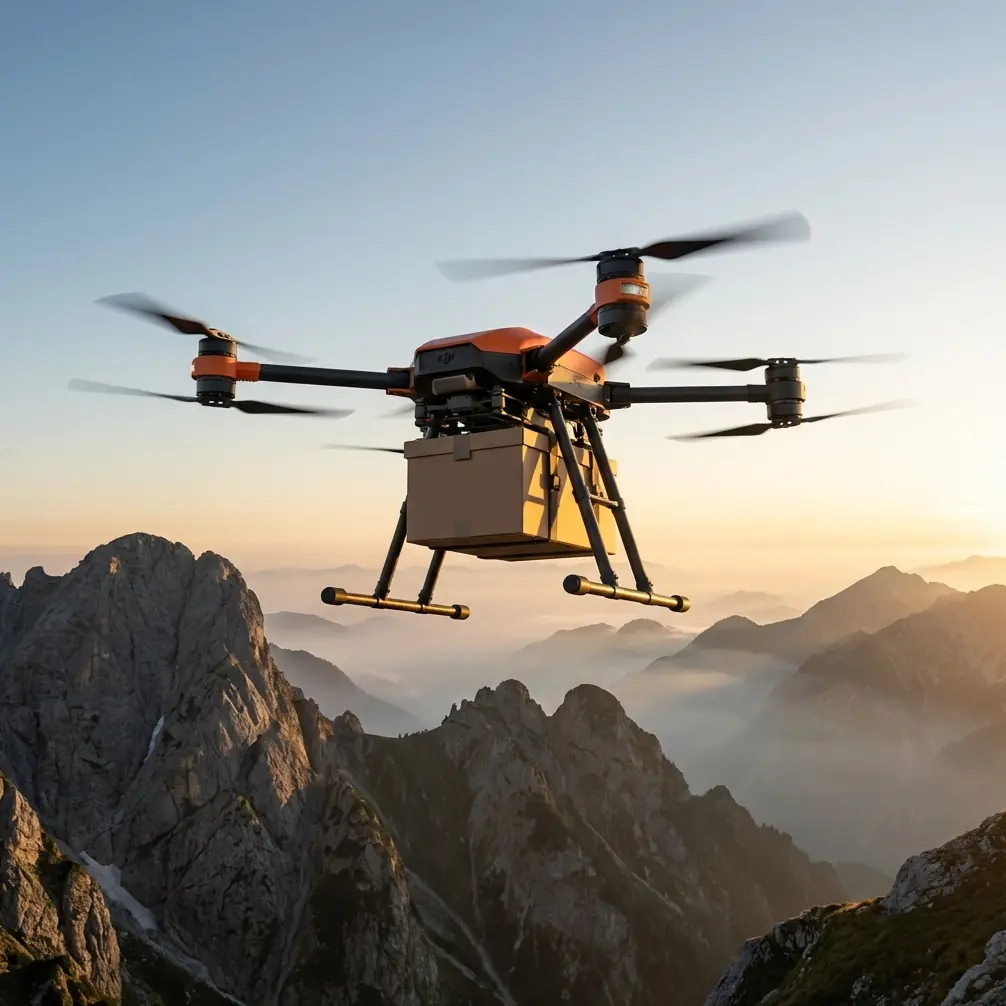
FlyCart 30 for Construction Sites in Complex Terrain: An Expert Workflow That Starts Beyond the Aircraft
META: A practical FlyCart 30 guide for construction site monitoring in complex terrain, covering payload planning, dual-battery discipline, winch operations, BVLOS thinking, route optimization, and why connected logistics matter as much as the drone.
When people talk about heavy-lift drones, the conversation usually gets trapped inside the airframe. Payload. Range. Batteries. Maybe the winch. Those things matter, especially with a platform like the FlyCart 30. But on a construction site spread across ridgelines, cut slopes, temporary access roads, and partially finished structures, the aircraft is only one piece of the job.
That distinction matters more now than it did even a few years ago.
A recent industry signal came from outside construction: a connected delivery model involving Papa Johns, Wing, and Google Cloud. The point was not the novelty of food delivery. The real takeaway was that drone operations are maturing into a broader infrastructure layer where AI systems, autonomous logistics, and aerial delivery work as one ecosystem rather than separate tools. For anyone evaluating the FlyCart 30 for construction site monitoring in difficult terrain, that idea is immediately useful. A drone does not create efficiency by flying alone. It creates efficiency when flight planning, site logistics, battery rotation, route decisions, and payload handoff all reinforce each other.
That is how I would approach the FC30 on a live jobsite.
Why the FlyCart 30 changes the construction monitoring equation
Construction monitoring in complex terrain is rarely just “inspection.” It is a chain of small logistics decisions under time pressure. The site team may need a sensor package moved to a slope bench before first light, a radio dropped near a blind area, replacement parts delivered to a crane team, or a line lowered into a location where landing is unsafe or impossible. In these conditions, payload ratio is not just a specification. It is a planning constraint that affects how many separate sorties you need, how much battery margin you hold back, and whether the operation saves time over ground access.
The FlyCart 30 stands out because it is designed around practical transport and delivery mechanics rather than only image capture. That matters on construction sites where monitoring often blends into support logistics. A drone that can move tools, sensors, tripods, consumables, or communication devices into elevated or obstructed work zones can reduce walking time, vehicle movement, and exposure on unstable paths. If the site is in mountainous or broken terrain, the operational value rises quickly.
The winch system is central to that. On many jobsites, a landing zone is the exception, not the rule. You may have rebar congestion, active machinery, muddy benches, scaffold interference, or newly graded slopes that are not suitable for touchdown. A winch-based delivery method lets the aircraft remain clear of obstacles while lowering the load to a controlled point. For monitoring missions, that means you can place or retrieve equipment without forcing a landing in a marginal area.
The right mental model: treat FC30 as part of a site logistics network
The most useful lesson from that Papa Johns-Wing-Google Cloud example is not about consumer delivery at all. It is about integration. The article’s core argument is that drone delivery involves far more than the aircraft hardware and depends on broader logistics and software systems. That maps directly onto construction.
On a complex site, the FC30 should sit inside a connected workflow:
- Dispatch requests come from field supervisors, survey teams, or safety managers.
- Route optimization accounts for terrain, crane swing areas, exclusion zones, and temporary structures.
- Battery status is tracked against task urgency, not just state of charge.
- Payload handoff is standardized so the receiving crew is ready before launch.
- Flight records and delivery outcomes feed back into planning for the next sortie.
That is how drone operations stop being an experiment and start functioning like infrastructure.
If a site team only asks, “Can the FC30 carry this?” they are asking too late. The better question is, “What workflow lets this payload move with the least site friction and the highest safety margin?” The answer usually involves route timing, hover exposure, battery reserve, and whether a winch drop is smarter than a landing.
A practical tutorial for site monitoring missions
Here is the framework I recommend when using the FlyCart 30 for monitoring-related support on construction sites in complex terrain.
1. Classify the mission before you touch the aircraft
Not every construction monitoring task is the same. I break them into three categories:
Observation support Transporting cameras, sensor nodes, radios, or batteries to improve visibility into remote sections of the site.
Inspection access support Moving lightweight tools, tags, test kits, or communication devices to crews working in hard-to-reach elevated areas.
Rapid response logistics Delivering a needed item fast enough to avoid downtime, such as a measuring device, spare handheld unit, or replacement power source.
This matters because each category drives different battery and route decisions. Observation support often benefits from repeatable routes and scheduled delivery windows. Rapid response logistics may justify a more conservative battery threshold because delays are costly and field conditions may change while the aircraft is airborne.
2. Build the route around terrain and workflow, not straight-line distance
Route optimization is where many FC30 programs either become reliable or stay frustrating.
A straight path on the map may cross rotor wash-sensitive areas, pass too close to active lifting operations, or expose the aircraft to unpredictable wind effects along a cut slope. In broken terrain, route quality matters more than route length. If the mission is to support site monitoring, the ideal path is the one that produces the most predictable energy use and the cleanest payload handoff.
This is where the “connected ecosystem” idea from the delivery world becomes operationally significant. The broader system matters. You need site maps, active work-zone updates, weather observations, and a dispatch process that gives the remote team clear timing. Otherwise, a powerful drone spends too much time hovering, rerouting, or waiting for a receiving crew that is not in position.
For BVLOS-oriented planning, even if your actual operation depends on local approval and site-specific rules, the mindset is useful. Plan as if visual proximity will not solve weak coordination. That forces discipline into routing, communication, contingency planning, and landing or lowering procedures.
3. Use the winch system deliberately
The FC30’s winch capability is one of the strongest tools for complex terrain work, but only if crews resist the temptation to improvise.
A few best practices:
- Define a stable lowering zone with visual markers where possible.
- Standardize load packaging so it stays balanced during descent.
- Brief the receiving crew on approach direction and pickup timing.
- Avoid long hover holds while the ground team decides where they want the item.
- Use lowering operations where touchdown risk is higher than hover risk.
Operationally, this matters because the winch is not just a convenience feature. It protects mission continuity. On a steep construction site, every avoided landing reduces the chance of gear contamination, tip-over risk, or rotor interference from loose material.
For monitoring workflows, the winch also helps with equipment retrieval. If a remote sensor or compact camera unit needs to come back from a narrow bench or incomplete platform, the aircraft can recover it without committing to a landing profile in a questionable area.
4. Treat dual-battery management as a discipline, not a comfort blanket
The dual-battery architecture is one of the reasons a platform like the FC30 can serve serious site operations. But the field mistake I see most often is assuming that two batteries automatically equal flexibility. In reality, dual-battery systems reward consistency and punish sloppy rotation habits.
Here is the battery management tip I give every team after enough muddy, windy mornings on active jobsites:
Match battery pairs by behavior, not only by charge percentage.
If one pack consistently drops voltage faster under load, warms differently, or has been cycled harder than its partner, that pair will create uneven performance exactly when the aircraft is carrying a meaningful load over difficult terrain. Two packs both showing a high state of charge on the ground do not guarantee symmetrical performance in the air.
My field routine is simple:
- Keep battery pairs assigned and labeled as teams.
- Log which pair was used for heavier lift profiles versus lighter support sorties.
- Let both packs cool to a similar range before the next mission.
- Do not mix a freshly charged warm pack with one that has been sitting cooler in shade and expect identical behavior.
This sounds minor until you are working a route that includes altitude change, crosswind, and a hover for winch deployment. Then it becomes major. Uneven battery behavior can distort your reserve planning and shorten the margin you thought you had.
On construction sites, the consequence is not only shorter endurance. It is disrupted workflow. The receiving crew waits. The monitoring setup is delayed. A supervisor sends someone on foot because confidence in the air operation slips. Good battery discipline protects the credibility of the whole drone program.
5. Build in emergency thinking before the first lift
An emergency parachute feature should not be treated as marketing decoration. On complex terrain jobsites, it is part of risk architecture.
The operational significance is straightforward: when flights occur near structures, uneven ground, temporary installations, or worker pathways, a final protective layer matters. It does not eliminate the need for conservative planning, but it does change how you evaluate certain mission profiles. If the site has narrow usable corridors and very limited forced-landing options, redundancy and last-resort recovery systems become part of the mission approval logic.
That is especially true when the aircraft is doing more than transit. Winch operations and precision placement can increase hover time in constrained areas. The more precisely you need the aircraft to work, the more valuable your layered safety design becomes.
Where FC30 fits best on monitoring-heavy sites
The FlyCart 30 is most effective on construction projects where monitoring has a logistics component. Examples include:
- Mountain road or rail builds with long elevation changes
- Dam, quarry, or hillside stabilization projects
- Utility corridor construction where teams are spread across segmented access points
- Large industrial plants under expansion where ground routes are indirect or congested
- Remote civil works where small delays cascade into crew downtime
In each case, the aircraft is not replacing every vehicle trip. It is reducing the worst trips: the slowest, least efficient, or highest-friction movements tied to field visibility and coordination.
That is where the larger industry trend becomes relevant again. The drone delivery story highlighted by the Wing, Papa Johns, and Google Cloud partnership points toward a future where AI-guided dispatch, software-driven logistics, and autonomous aviation support each other. Construction will follow the same pattern. The FC30 will produce its best results when paired with digital work orders, route history, mission analytics, and predictable handoff procedures.
A site that simply owns the aircraft gets some value. A site that operationalizes the aircraft as part of its logistics stack gets much more.
What I would standardize on day one
If I were standing up a FlyCart 30 program for construction monitoring in difficult terrain, I would standardize five things immediately:
Dispatch format
Every request needs destination, payload type, urgency, receiving contact, and handoff method.
Route library
Create approved route templates for common flight paths instead of replanning every mission from scratch.
Battery pair logs
Track paired usage history, cooling condition, and heavy-load exposure.
Winch protocols
Use repeatable lowering heights, visual markers, and receiving crew commands.
Contingency thresholds
Set clear no-go and return criteria tied to wind, battery reserve, terrain corridor limits, and site activity.
Those basics do more for mission reliability than chasing theoretical maximum performance.
The bigger point
The FlyCart 30 is not interesting because it is a drone that can carry things. Plenty of people stop at that level. The more consequential insight is that a platform like this can act as a working link between monitoring, logistics, and field coordination on construction sites where terrain punishes inefficiency.
That is exactly why the recent delivery-sector narrative matters. When companies like Papa Johns, Wing, and Google Cloud are used to illustrate a connected commerce system, the underlying message is bigger than last-mile delivery. It is that the aircraft is only one node in a larger operational chain. Construction teams should pay attention. The same logic applies when the “customer” is a survey lead on a ridge bench waiting for a replacement sensor battery, or a site manager needing a fast equipment drop to restore visibility across a remote work front.
If you are designing an FC30 workflow now, build it as infrastructure from the start.
If you want to compare route setups, battery rotation practices, or winch procedures for your site conditions, you can message our operations team here.
Ready for your own FlyCart 30? Contact our team for expert consultation.