
FlyCart 30 for Wildlife Logistics: What the Amazon Drone
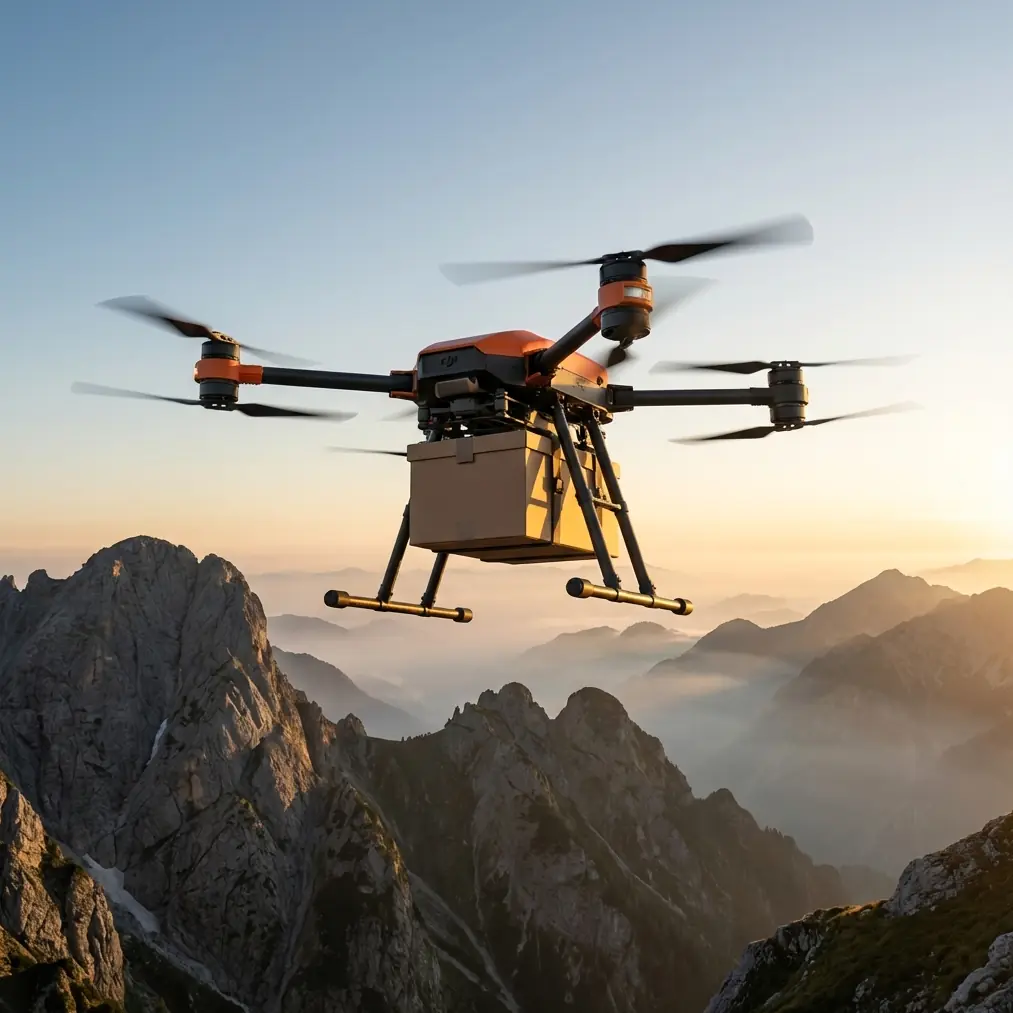
FlyCart 30 for Wildlife Logistics: What the Amazon Drone Dream Gets Right—and What Real Operators Still Have to Solve
META: A field-focused FlyCart 30 article for remote wildlife operations, covering route limits, payload logic, BVLOS realities, winch use, dual-battery safety, and why pre-flight cleaning matters.
The easiest way to misunderstand cargo drones is to start with the headline promise.
A parcel in 30 minutes. A drone guided by GPS. A service radius of 16 kilometers from a warehouse. That public vision, famously introduced by Jeff Bezos on CBS’s 60 Minutes on December 1, did something very effectively: it gave the general public a clean, memorable picture of what drone delivery could look like. It also compressed a difficult operational problem into a simple consumer story.
For people evaluating the FlyCart 30 for remote wildlife work, that gap matters.
Because out in the field, nobody cares whether an aircraft sounds futuristic. They care whether it can move the right load, over the right route, with enough control margin to protect equipment, terrain, and wildlife. They care whether the aircraft can be recovered safely after a dusty morning launch. They care whether the system still performs when the task is not suburban parcel drop-off, but moving camera traps, veterinary supplies, radio collars, feed samples, batteries, or sensor kits into isolated areas where ground access is slow or disruptive.
That is where the FlyCart 30 becomes a serious platform to study—not as a symbol of drone delivery hype, but as a working logistics tool.
The real problem in wildlife operations is not speed alone
Remote wildlife programs usually inherit the same set of constraints.
Sites are far from roads. Access windows are narrow. Ground vehicles can damage habitat or simply fail to reach the target area in wet conditions. Teams often need to move awkward but mission-critical items: survey equipment, medical kits, traps, sample containers, communications gear, field batteries. Sometimes the cargo is not especially heavy, but it is time-sensitive. Sometimes it is the opposite: routine, repeatable, but labor-intensive enough to drain field staff.
This is why cargo drones are attractive. Not because they make a dramatic video, but because they can remove a recurring logistics bottleneck.
The Amazon scenario described a highly controlled distribution model: GPS navigation, a warehouse-centered radius of 16 kilometers, and a 30-minute delivery ambition. Even the original public framing acknowledged that reality would take time, with outside experts suggesting the concept might still be four or five years away from practical realization. That detail is still useful today, not as a critique of drone delivery itself, but as a reminder that aircraft capability is only one part of the system.
The rest is operations.
A wildlife team scouting remote areas with the FlyCart 30 is not building a mass-consumer network. It is building a repeatable field workflow. That changes how you judge the aircraft.
Why FlyCart 30 fits a field logistics model better than a publicity model
The FlyCart 30 should be assessed through the lens of payload ratio, route design, terrain interaction, and recovery discipline.
In wildlife scouting, payload ratio matters because every kilogram on board has a job. You are not trying to impress a customer with a doorstep arrival. You are trying to maximize useful cargo without creating unnecessary risk or reducing endurance below operationally sensible levels. An aircraft with a strong cargo profile is only valuable if the route plan, landing or delivery method, and reserve margin all align with that load.
That is one reason the winch system deserves more attention than it often gets.
A winch-equipped delivery profile can be operationally significant in places where landing is the worst option. Uneven terrain, scrub canopy, loose debris, soft ground, and wildlife sensitivity all complicate touchdown operations. A controlled suspended drop or lift can let the aircraft remain in a more stable hover zone while the payload is lowered into a small clearing or onto a prepared point. For conservation teams, that can reduce rotor wash impact on the immediate ground area and avoid forcing a landing in uncertain conditions.
This is not a flashy feature. It is a practical one.
The same goes for BVLOS planning. In remote scouting scenarios, beyond visual line of sight is often where the economic case for cargo drones begins to make sense. If every sortie requires operators to physically chase the aircraft across difficult terrain, much of the logistics benefit disappears. But BVLOS is not just a checkbox in a brochure. It requires route optimization, terrain awareness, communications reliability, procedural discipline, and jurisdiction-specific compliance. A drone may be technically capable of extended operations, yet still be operationally constrained by the site, the mission profile, or the team’s readiness.
That is exactly why the old 16-kilometer delivery-radius idea still resonates. It reminds us that route geometry defines the mission as much as aircraft specs do. Radius is not reach in the real world. A straight-line map circle can ignore elevation changes, wind patterns, obstacle clearance, launch site limitations, and recovery contingencies. In wildlife environments, route optimization is not only about shortest path. It is about safest path, quietest path, and most repeatable path.
Safety features only matter if crews maintain them properly
There is another point that tends to get overlooked in cargo-drone discussions: safety hardware is not self-executing.
People like to mention emergency parachutes, dual-battery redundancy, and autonomous safeguards as if their presence alone settles the risk question. It does not. Those systems matter because they buy time, provide fallback layers, and reduce single-point vulnerability. But they still depend on inspection quality and maintenance culture.
A simple pre-flight cleaning step illustrates this better than any marketing summary.
Before launching the FlyCart 30 in dusty, grassy, or muddy field conditions, crews should treat the cleaning of critical safety-feature areas as part of mission readiness, not housekeeping. That means clearing contamination from battery interfaces, checking vent and latch areas, wiping down sensor windows, inspecting winch line paths for grit or plant fibers, and making sure parachute-related housing or deployment zones are free from obstructions and residue. Debris in the wrong place can interfere with fit, sensing, cooling, or deployment. In wildlife terrain, contaminants are normal. Ignoring them is optional.
The dual-battery architecture is operationally significant because remote work rarely offers forgiving recovery conditions. If one power source underperforms, the aircraft needs enough resilience to avoid turning a logistics mission into a retrieval incident. But redundancy only helps when battery health, seating, connection integrity, and temperature management are verified with discipline. In the same way, an emergency parachute can be an important last-resort layer, especially when operating over inaccessible ground, but crews need to ensure that nothing from transport, dust buildup, or rushed packing compromises deployment readiness.
Pre-flight cleaning sounds minor. It isn’t. In the field, small neglected details become major failure multipliers.
The wildlife use case changes how success should be measured
Consumer delivery narratives are built around the end recipient’s experience. Wildlife logistics should be measured differently.
A successful FlyCart 30 mission might mean delivering field sensors to a ridge without sending a vehicle through sensitive habitat. It might mean moving veterinary consumables to a temporary base before temperatures rise. It might mean resupplying batteries to a camera network while leaving animal movement corridors less disturbed than they would be under repeated foot or vehicle traffic.
That is a fundamentally different value proposition from “order now, receive in 30 minutes.”
And yet the comparison is useful. The Amazon concept worked as public communication because it translated drone logistics into a familiar promise: speed within a defined service area using GPS-based navigation. For professional operators, the lesson is not to imitate the slogan. The lesson is to build a mission architecture where the promise is operationally honest.
With the FlyCart 30, that means asking hard questions early:
- What load profile is truly routine, not occasional?
- Does the payload ratio still leave enough margin for wind, route deviation, and return reserves?
- Is the winch system the safer delivery method than landing at destination?
- Are BVLOS procedures mature enough for the actual terrain, not idealized maps?
- Do dual-battery checks and parachute inspections happen every time, even when the mission feels routine?
- Has the route been optimized around habitat sensitivity as well as distance?
Those are not abstract technicalities. They determine whether a drone becomes a trusted field asset or an expensive experiment.
Route optimization in wildlife work is about minimizing disturbance, not just maximizing efficiency
In commercial logistics, route optimization is usually discussed in terms of time and energy. For wildlife scouting, it should also include ecological sensitivity.
A mathematically efficient route may cross nesting zones, migration paths, or areas where repeated noise signatures create avoidable disturbance. An experienced logistics lead will build route libraries that balance energy use with environmental caution. Sometimes that means flying slightly longer corridors that maintain more predictable separation from sensitive locations. Sometimes it means changing altitude strategy, launch timing, or delivery point geometry.
This is one of the biggest differences between a warehouse-delivery fantasy and a functioning conservation logistics program. The aircraft is only one layer. The mission design is the real product.
That is also why training matters. A capable platform in inexperienced hands tends to produce either timid underuse or overconfident misuse. Teams need drills that cover suspended-load behavior, degraded weather decisions, reroute logic, emergency response, and contamination-control habits after every field cycle. If your crew has never practiced winch operations in the same brush, dust, and uneven airflow they will face on a live mission, then the first real sortie is still a test.
Why the “four or five years away” lesson still matters
One striking detail from the public debate around early drone delivery was the expert skepticism that such systems would take at least four or five years to become real at scale. That was a healthy correction to technological theater. It forced attention back to airspace, safety, infrastructure, and operational constraints.
For FlyCart 30 users in wildlife operations, that lesson remains current.
The obstacle is rarely whether the aircraft can lift cargo at all. The obstacle is whether the entire mission chain is mature enough: planning, permissions, batteries, weather decisions, maintenance, route control, drop accuracy, field communications, and post-flight checks. Commercial drone logistics does not fail because drones are imaginary. It fails when teams underestimate the boring parts.
The good news is that the boring parts are manageable.
They are also where professional operators separate themselves from headline-driven adopters.
A FlyCart 30 program built for remote wildlife scouting should be conservative in the best sense of the word. Standardized cleaning before every launch. Strict battery inspection. Winch use where landing introduces unnecessary surface risk. BVLOS only when the route, crew, and regulatory framework support it. Payload planning that respects margin instead of chasing maximum theoretical numbers. Delivery corridors chosen for habitat respect as much as efficiency.
That is what turns a cargo drone into a reliable field instrument.
A practical way to think about FlyCart 30 in the field
If I were framing this for a conservation or remote-operations team, I would say it plainly: the FlyCart 30 is most useful when you stop treating it like a futuristic courier and start treating it like an aerial logistics node.
That mindset changes everything.
You do not ask whether it can reproduce a television-ready 30-minute promise inside a 16-kilometer radius. You ask whether it can reduce habitat intrusion, shorten supply loops, improve staff allocation, and deliver critical gear safely into places where ground transport is inefficient or disruptive. You ask whether your safety features are backed by inspection discipline. You ask whether your routes are repeatable enough to become standard operating patterns rather than improvised flights.
If your team is currently mapping out that kind of workflow, it helps to compare mission assumptions with operators who have already thought through payload methods, safety layers, and field constraints. A direct project discussion can save weeks of trial and error: message a FlyCart 30 field specialist here.
The public imagination was captured years ago by the idea of packages descending from the sky shortly after checkout. Useful image. Limited model.
In remote wildlife scouting, the better story is quieter and far more practical: moving the right equipment, at the right time, to the right place, with less ground disruption and more operational control. That is where the FlyCart 30 has to prove itself. Not on stage. In the field.
Ready for your own FlyCart 30? Contact our team for expert consultation.