
FlyCart 30 for Urban Power-Line Spraying: What the Drone
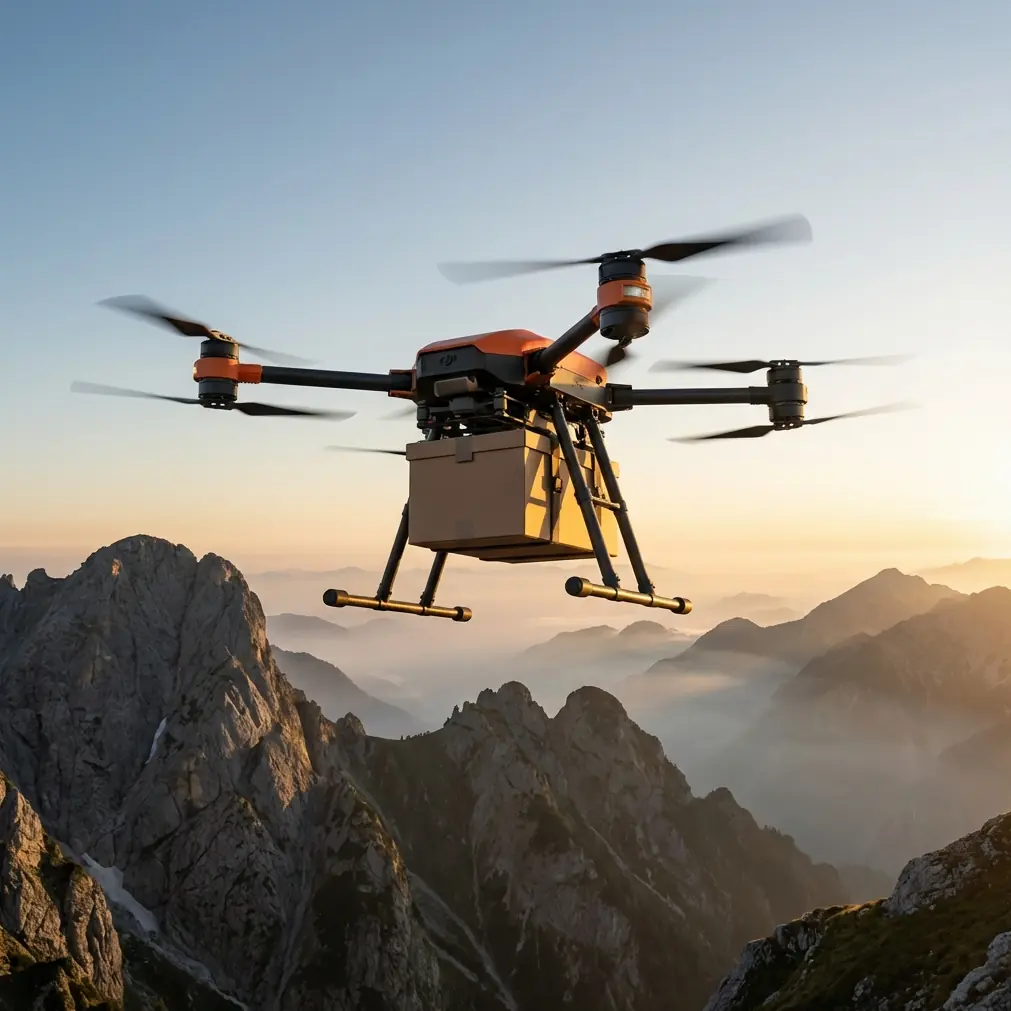
FlyCart 30 for Urban Power-Line Spraying: What the Drone-Delivery Dream Gets Right, and What Real Operators Still Have to Solve
META: A technical review of FlyCart 30 for urban power-line spraying, focused on route limits, payload ratio, winch workflow, BVLOS realities, emergency parachute checks, and why pre-flight cleaning matters.
I look at the DJI FlyCart 30 from a logistics perspective first, not as a brochure object and not as a futuristic symbol. That matters because urban power-line spraying is one of those jobs where the drone is only part of the system. The real work sits in the chain around it: launch setup, route design, fluid handling, risk controls, rooftop access, traffic separation, and what happens when a job that looked simple on paper starts colliding with city geometry.
That is why an old headline about drone delivery still says something useful today.
Years ago, Amazon publicly floated the idea of drone parcel delivery within 30 minutes, using GPS navigation for customers located within a 16-kilometer radius of a warehouse. The vision landed well on television. It was unveiled on CBS’s 60 Minutes, and it did what bold public concepts often do: it made people imagine the endpoint before the industry had solved the middle. Experts at the time pointed out that practical deployment was still likely four to five years away because the hard problems were not the press-friendly ones.
For operators evaluating FlyCart 30 in an urban utility workflow, that gap between concept and field reality is the whole story.
The reason the Amazon reference matters is not because power-line spraying and package delivery are the same mission. They are not. It matters because both rely on the same operational spine: GPS-guided route execution, constrained service radii, and the assumption that the environment will behave. In a city, it rarely does. Signal reflections, rooftop turbulence, narrow stand-off margins near structures, moving people below, and limited emergency landing options all push the aircraft from “capable” into “must be managed correctly every single sortie.”
So let’s review FlyCart 30 the way an actual urban utility team should.
The first question is not lift. It is task fit.
FlyCart 30 gets attention because it is built to move material. That naturally leads people to ask whether a transport platform can support spraying power lines in dense areas. The answer depends less on headline payload and more on payload ratio.
Payload ratio is one of the most overlooked metrics in drone field economics. If too much of the aircraft’s energy and flight envelope is consumed just carrying the spray module, line, mounting hardware, and liquid, the practical productivity drops fast. The drone may still fly. That does not mean it is working efficiently.
For urban power-line spraying, the ratio has to support three things at once:
- Enough fluid on board to avoid constant interruption.
- Enough battery reserve to maintain a safe stand-off and controlled return.
- Enough control authority to stay predictable around poles, conductors, and crosswinds accelerated by buildings.
This is where FlyCart 30 becomes interesting. A cargo-oriented platform can bring useful structural robustness to a utility job, especially when the workflow is built around repeated point-to-point movement between staging area and treatment zone. But robustness alone does not guarantee good spray performance. If you are evaluating it seriously, you need to model the full cycle time, not just the airborne segment: refill, battery swap, transit, hover time, and deconfliction pauses.
In urban work, those pauses are not minor. They define throughput.
Why the delivery dream matters for BVLOS planning
The Amazon concept assumed a controlled radius: 16 kilometers from warehouse to customer. Operationally, that detail is more valuable than the 30-minute promise. Radius is planning. Radius is infrastructure. Radius is where route optimization starts to become either feasible or misleading.
With FlyCart 30, especially in utility-adjacent work, the temptation is to treat BVLOS as a direct path problem. But urban power-line spraying is not simply “fly there, do the task, come back.” Every segment may have its own risk class. A straight line on the map can cross roads, schools, rail corridors, rooftop HVAC clutter, or localized RF noise pockets.
That makes route optimization a layered exercise. The best route is often not the shortest route. It is the route that preserves decision space.
The old drone-delivery promise of GPS navigation within a defined radius showed the public one half of the equation: positioning. It did not show the other half: exception management. For a FlyCart 30 operator, especially one looking at BVLOS-style operational concepts in a city, exception management is where the program succeeds or fails. If the aircraft can hold route accurately but your team has no clean answer for a blocked launch area, a sudden pedestrian concentration below, or a weather shift between buildings, GPS accuracy alone does not rescue the mission.
That is the practical translation of those early expert warnings that real deployment would take four or five years. The aircraft was never the only barrier. The operating framework was.
The winch system changes the workflow more than many teams expect
One of the most operationally significant design features in this class is the winch system. Even if the spraying task is not pure cargo delivery, the winch can reshape how the crew approaches urban access.
In utility environments, direct touchdown is not always the cleanest option. Roofs may be cluttered, street-level space may be restricted, and some treatment locations may be easier to service by holding a safe hover and lowering or recovering gear rather than landing in a compromised zone. That does not mean every urban job should use the winch, but it does mean the platform can support more flexible staging logic than a conventional spraying drone.
That flexibility matters because urban line work often punishes unnecessary landings. Every landing in a constrained area adds dust, debris, bystander risk, and rotor wash complications. If your team can reduce those landing cycles, the system tends to become calmer and more repeatable.
Still, the winch only helps if the crew has disciplined handling procedures. Lines, hooks, and attachment points introduce their own failure modes. Tangling, partial seating, and contamination are not abstract concerns. They show up after long days and rushed resets.
Which leads to a small but critical point that too many teams skip.
Pre-flight cleaning is not housekeeping. It is a safety control.
Before any urban spraying sortie, the safety features need to be physically clean enough to do their job. That sounds basic. It is not.
If the aircraft is operating near power infrastructure, rooftops, or construction-adjacent grime, dust and residue accumulate fast. That affects sensors, latches, venting, connector surfaces, and moving elements tied to emergency systems. On a platform where emergency parachute readiness is part of the risk picture, a pre-flight cleaning step should not be treated as optional cosmetic care.
I would make it explicit in the checklist:
- Clean and inspect the parachute compartment area and release-related surfaces.
- Check that no dried spray residue, dust, tape fragments, or transport debris interfere with deployment pathways.
- Wipe sensor faces and confirm no film is left that could affect detection logic.
- Inspect winch line path and attachment points for grit and fiber contamination.
- Verify dual-battery contact areas are clean and seated correctly before power-on checks.
This is the kind of detail that separates an aircraft that is technically equipped for urban risk mitigation from one that is merely carrying those features in theory. Emergency parachute systems are often discussed as if they are binary: present or absent. In practice, readiness is procedural. A dirty system is not a ready system.
Dual-battery architecture is valuable, but only if you budget reserve honestly
Urban power-line spraying tends to produce false confidence because the work zone can look geographically compact. Crews see a short segment of infrastructure and assume the energy picture is simple. It usually is not.
Hovering near assets, repositioning around structures, aborting approaches, and waiting for safe windows can drain more time than transit. That is where dual-battery design earns its place. Redundancy and continuity matter, especially when the aircraft is carrying mission equipment over built-up ground.
But operators should resist turning dual-battery capability into psychological permission to run thinner margins. Reserve is there to preserve options, not to justify aggressive planning. In urban operations, the difference between a normal return and a pressured return can be a single delayed decision around an obstacle corridor or a blocked recovery point.
The more mature approach is to build mission plans around “usable productivity” rather than theoretical maximum endurance. If your route optimization software says a string of jobs is possible on paper, test that plan against real hover penalties, wind channels, and contingency repositioning. Then subtract again.
Spraying power lines in a city is a precision logistics problem
That might sound odd to teams coming from a purely aviation mindset, but it is true. The aircraft does not just perform the mission. It connects multiple controlled handoffs.
Chemical or treatment fluid handling has to be disciplined. Crew positions have to be defined. Rooftop or street-level staging has to be legal and safe. Public separation has to be maintained. Communications have to survive noise and vertical clutter. Recovery points have to be realistic, not optimistic.
This is another place where the Amazon drone-delivery story remains useful. A public audience heard “30 minutes.” An operator heard “warehouse radius, GPS routing, and unresolved deployment complexity.” Those are very different interpretations. The first is marketing gravity. The second is operations gravity.
For FlyCart 30, especially in urban utility service, you want to think like the second group.
Where FlyCart 30 can make sense
I see the strongest fit in structured, repeatable urban service corridors where the team can standardize:
- launch and recovery zones,
- battery rotation,
- fluid refill procedures,
- route segmentation,
- emergency decision trees,
- and communication between visual observers and pilot-in-command.
If the utility environment is dense but predictable, FlyCart 30’s cargo DNA can be an advantage. The airframe philosophy aligns well with repetitive task cycles, support equipment movement, and disciplined logistics. That is particularly true when the mission includes moving gear to awkward access points as part of the day’s work, not just spraying itself.
If your team is discussing program design and wants a practical conversation around field configuration rather than generic claims, this direct line can help start the right kind of planning: message the operations desk.
What to evaluate before committing the platform to this mission set
A serious technical review should answer five questions.
1. Can the payload ratio support actual spray productivity?
Do not accept “it can lift it” as the answer. Model fluid weight, mounting hardware, environmental reserve, and expected hover inefficiency.
2. Does the winch system add operational safety or just complexity?
For some urban sites it can reduce risky landings. For others it adds unnecessary handling steps.
3. Is your BVLOS or extended-visual workflow genuinely mature?
GPS route capability is not the same thing as a robust route operation. The Amazon example showed how easy it is to sell the map and omit the exceptions.
4. Are emergency systems integrated into daily maintenance?
The pre-flight cleaning step should be written, verified, and owned. Emergency parachute readiness is a living condition, not a spec-sheet line.
5. Are dual-battery reserves being used conservatively?
Compact urban jobs often consume more energy than they appear to.
The real takeaway
FlyCart 30 should not be judged by whether it resembles the old dream of drones zipping around cities on autopilot. That dream was useful because it forced the industry to confront route limits, GPS dependence, and the gap between a polished demo and a stable service model. The facts from that episode still resonate: a 30-minute target, a 16-kilometer operating radius, and expert skepticism that practical deployment would take years. All three are reminders that aviation capability and operational readiness are not the same thing.
For urban power-line spraying, that distinction is everything.
A good FlyCart 30 program will be built on exact route planning, disciplined payload management, honest battery reserves, clean emergency systems, and a crew that treats logistics as part of flight safety. Ignore those pieces, and even a very capable platform becomes hard to trust in the places where trust matters most: above streets, beside buildings, and near critical infrastructure.
Handled properly, though, the aircraft can be more than a cargo drone applied out of context. It can become a structured utility tool in a workflow designed for city constraints rather than one that merely hopes to overcome them.
Ready for your own FlyCart 30? Contact our team for expert consultation.