
Surveying Mountain Power Lines With the FlyCart 30
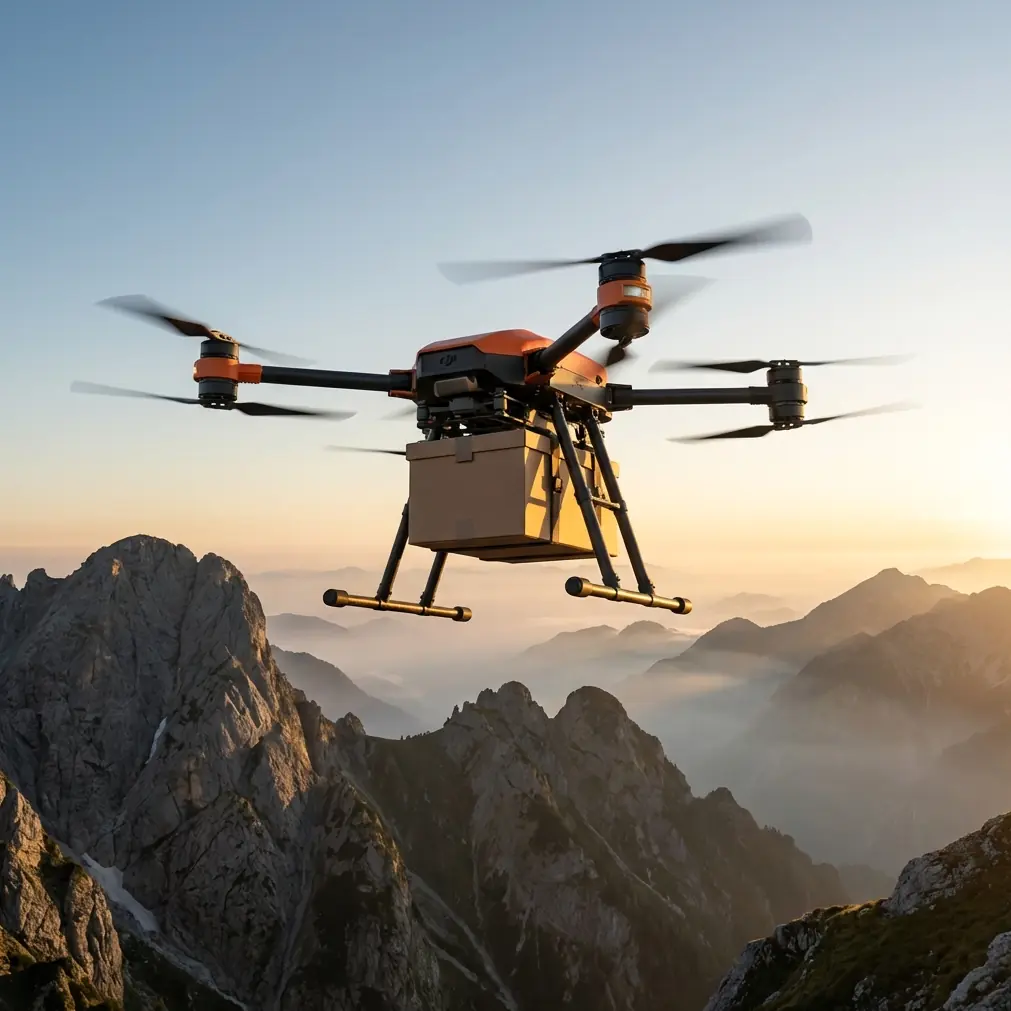
Surveying Mountain Power Lines With the FlyCart 30: What Actually Matters in the Field
META: Practical FlyCart 30 best practices for mountain power line surveying, with a field-focused look at route planning, winch use, dual-battery workflow, BVLOS considerations, and why immersive Earth visualization changes operator judgment.
Mountain power line work has a habit of exposing weak assumptions.
On paper, a route can look simple: follow the corridor, inspect towers, capture imagery, move to the next span. In steep terrain, that plan starts breaking apart. Ridge lift changes the aircraft’s behavior. Valleys interrupt signal consistency. Access roads disappear. And every extra landing to swap batteries or reposition a crew turns into lost time.
That is why the FlyCart 30 deserves a more practical conversation than the usual spec-sheet treatment. For teams surveying power lines in mountain environments, the aircraft is not interesting because it is large or because it carries the DJI badge. It matters because its design choices map directly to the friction points that make upland utility work expensive.
I say that as someone who thinks like a logistics lead first. The aircraft has to fit the route, the terrain, and the crew’s workflow. Otherwise, even strong flight performance gets wasted.
Start with the right mental model: mountain surveying is about reading a moving system
There is a lesson buried in an unexpected place: the reopened Shanghai Science and Technology Museum. In 2026, one of its most talked-about exhibits, “Earth,” in the “Symbiotic Planet” section, drew crowds not because it showed a static globe, but because it made planetary change visible. Visitors stood in front of a giant dome-style display and watched clouds move across the Earth’s surface and forests shift over time. Some people arrived early just to avoid the lines. Others went back multiple times to see the same exhibit under different lighting conditions.
That detail matters more to drone operations than it may seem.
When people watch dynamic cloud layers and land-cover change on a curved visual surface, they stop thinking in flat screenshots. They start understanding that Earth is not a backdrop. It is a living, changing environment. For mountain power line surveying, that is exactly the mindset operators need. A transmission corridor through high ground is not just a line on a map. It is a weather channel, a wind funnel, a visibility problem, and sometimes a logistics trap.
The crews that perform best with the FlyCart 30 usually do one thing differently: they visualize terrain and atmosphere together, not separately. The museum exhibit became popular because it turned “the Earth is a whole” from an abstract sentence into something visitors could feel. In the field, that same systems view helps operators anticipate where rotors will work harder, where route geometry becomes inefficient, and where a safer standoff is smarter than a closer pass.
This is also where FlyCart 30 stands apart from many lighter platforms used by inspection teams. Competitors may be easier to carry, but when the mountain starts dictating the mission instead of the pilot, platform resilience and logistics architecture matter more than backpack convenience.
Why the FlyCart 30 fits mountain utility corridors
The product focus here is surveying, but the FlyCart 30 comes from a transport-minded design philosophy. That is not a drawback. It is exactly why it can be useful on mountain power line work.
A cargo-oriented airframe tends to be built around stable lift, controlled handling under changing load conditions, and reliable mission continuity. For utility teams, that translates into operational advantages even when the payload is not a package but a task-specific sensor setup, field supplies, or support gear delivered to hard-to-reach staging points.
The key phrases people throw around with this platform—payload ratio, winch system, BVLOS workflow, route optimization, emergency parachute, dual-battery—are not marketing decoration. In the mountains, each one touches a real constraint.
1. Payload ratio affects how flexible your survey plan can be
If you are surveying power lines in rugged terrain, payload ratio is not just a lifting statistic. It determines whether the aircraft can carry the exact sensing package and still maintain a practical mission profile. It also affects whether the same platform can support mixed tasks on the same day.
That matters because mountain utility crews rarely do one perfectly isolated job. A corridor inspection can become a tower-top verification, a component resupply, or a delivery of tools to a team that is climbing from the opposite side. A platform with a stronger payload-to-airframe balance gives the crew room to adapt. Competitor models optimized narrowly for visual inspection may perform well in short, clean flights, but they often become single-purpose tools. The FlyCart 30’s utility mindset gives it broader field value.
For a logistics lead, that means fewer vehicle movements and fewer separate aircraft deployments.
2. The winch system solves a mountain problem that landing gear cannot
Mountain terrain is full of landing zones that technically exist but are operationally bad. Sloped ground, loose rock, brush, snow patches, uneven tower clearings—none of these are places where you want to force unnecessary touchdowns.
A winch system changes the equation.
Even if your primary mission is corridor surveying, the ability to lower or recover items without landing can support the inspection itself. A crew may need a replacement sensor module, a rope, a small tool kit, or a field radio delivered to a tower access point. More importantly, the winch allows the aircraft to maintain safer rotor clearance from unstable surfaces while still completing support tasks. That lowers the exposure created by repeated landing attempts in constrained terrain.
Against competitors, this is one of the FlyCart 30’s most practical advantages. Many drones can get to a mountain site. Fewer can interact with that site usefully when the ground is working against them.
3. Dual-battery workflow is less about endurance than about continuity
People tend to treat dual-battery architecture as shorthand for flight time. That is too simplistic.
On mountain power line routes, continuity is often worth more than peak duration. A dual-battery system can support steadier power management, better mission planning around partial legs, and more predictable decision-making when crews are operating far from easy road access. If one valley section takes longer than forecast because wind conditions force a route adjustment, the operational value is not just “more minutes.” It is the fact that the crew is not cornered into a rushed return decision.
That changes behavior. Pilots make better calls when they have margin.
It also helps with route segmentation. Rather than forcing the day into oversized missions that chase endurance records, teams can break corridors into cleaner blocks, knowing the aircraft power setup supports disciplined execution. That is how route optimization becomes real instead of theoretical.
How to plan a FlyCart 30 mountain survey route the smart way
A good mountain survey begins before the aircraft leaves the ground.
Build the route around terrain transitions, not tower count
Too many plans are built by counting structures. That works poorly in mountains because the energy cost of flight is not evenly distributed from tower to tower. A short span across a saddle may be harder than a longer segment along a stable contour.
Instead, divide the route by terrain behavior:
- ridge crossings
- narrow valleys
- leeward turbulence zones
- sheltered staging points
- line-of-sight break areas
The museum example comes back here. People revisited the “Earth” exhibit at different times of day specifically to see how light changed the experience. Mountain utility crews should think the same way about environmental variation. The corridor at 8 a.m. is not the corridor at 2 p.m. Light angle changes visibility on conductors and insulators. Surface heating can alter air movement near slopes. If an exhibit can become meaningfully different under shifting light, so can a survey route.
Use BVLOS only when the operational chain is mature enough
BVLOS can transform mountain utility work because the terrain often makes repeated manual repositioning inefficient. But BVLOS is not a shortcut. It is a systems discipline.
For FlyCart 30 teams, that means:
- route geometry must be pre-validated
- communication and observation procedures must be standardized
- emergency diversion points must be known in advance
- crew roles must be unambiguous
If your route optimization depends on heroic improvisation, you are not ready for BVLOS. You are just extending risk farther down the valley.
The benefit of FlyCart 30 in this context is that its mission profile supports structured corridor operations better than ad hoc consumer-style flying. That gives professional teams a stronger base for repeatable procedures.
Protect the mission with emergency thinking, not just flight thinking
An emergency parachute is easy to mention and easy to underestimate. In mountain utility environments, it has operational significance because terrain reduces your margin for benign failure. A controlled emergency response option can matter when the alternative is a descent path toward rock faces, tree cover, or inaccessible slopes.
This should influence route planning from the start. Do not ask only, “Can the drone fly here?” Ask, “If the aircraft has a serious problem here, what outcome are we accepting?” That question separates professional planning from optimistic planning.
Best practices for FlyCart 30 crews surveying mountain lines
Keep the aircraft high-value, the task modular
Do not make the aircraft carry every problem at once. Use the FlyCart 30 for the hard parts: difficult access, constrained support delivery, and the demanding legs of the inspection route. Keep field workflows modular so the aircraft’s capacity is spent where it returns the most value.
Treat support delivery as part of inspection efficiency
This is where a transport-capable platform beats lighter competitors. If your survey team on the far side of a ridge needs a battery, tool, or replacement component, solving that with the same aircraft can save an entire vehicle detour. The mission then becomes more than image capture. It becomes route support.
Train crews to read terrain visually, not just digitally
Maps, 3D models, and telemetry matter. But crews still need visual intuition. The popularity of Shanghai’s dome-style Earth display says something basic and true: when dynamic changes are shown in an immersive format, people understand complex systems faster. Utility teams can borrow that lesson. Brief crews using animated terrain and weather overlays, not static route diagrams alone. The better the mental picture, the cleaner the field decisions.
Use repeat visits to refine corridor timing
The museum had visitors coming back two or three times because the same visual subject felt different under changing conditions. Mountain survey routes behave the same way. If one corridor section consistently produces unstable imagery or inefficient flight behavior at a certain hour, stop treating that as bad luck. Build a timing matrix and refine the route.
That is the kind of process improvement that compounds across the season.
Where FlyCart 30 really outperforms the usual alternatives
The simplest comparison is this: many competing drones are good at getting eyes on assets. The FlyCart 30 is better when the mission also has to move capability through difficult terrain.
That difference is huge in the mountains.
If your operation is limited to short, road-accessible pole checks, a lighter aircraft may be enough. But once the corridor runs through high ground, once the nearest crew access is inconvenient, once your inspection day includes support delivery, repositioning friction, and variable environmental conditions, the FlyCart 30 starts looking less like an oversized option and more like the platform that was designed for the real job.
Its edge is not one flashy feature. It is the way payload ratio, winch system utility, dual-battery continuity, structured BVLOS planning, and emergency protection work together.
That is what serious field platforms do. They reduce the number of compromises you have to make.
Final field note from a logistics perspective
If you are evaluating the FlyCart 30 for mountain power line surveying, do not ask whether it can fly the route. Ask whether it can reduce the total mission burden around the route.
That means fewer unnecessary landings. Fewer crew relocations. Fewer broken workflows. Better support to remote teams. More resilient planning when the mountain changes the plan.
If you want to compare your corridor layout or staging concept against this type of workflow, send over the route details here: message our operations desk.
The best drone for mountain utility work is rarely the one with the prettiest headline specification. It is the one that keeps the mission coherent when terrain, distance, and timing all start pulling in different directions. In that kind of environment, the FlyCart 30 makes a strong case for itself.
Ready for your own FlyCart 30? Contact our team for expert consultation.