
FlyCart 30 for Mountain Solar Farm Surveying: The Altitude
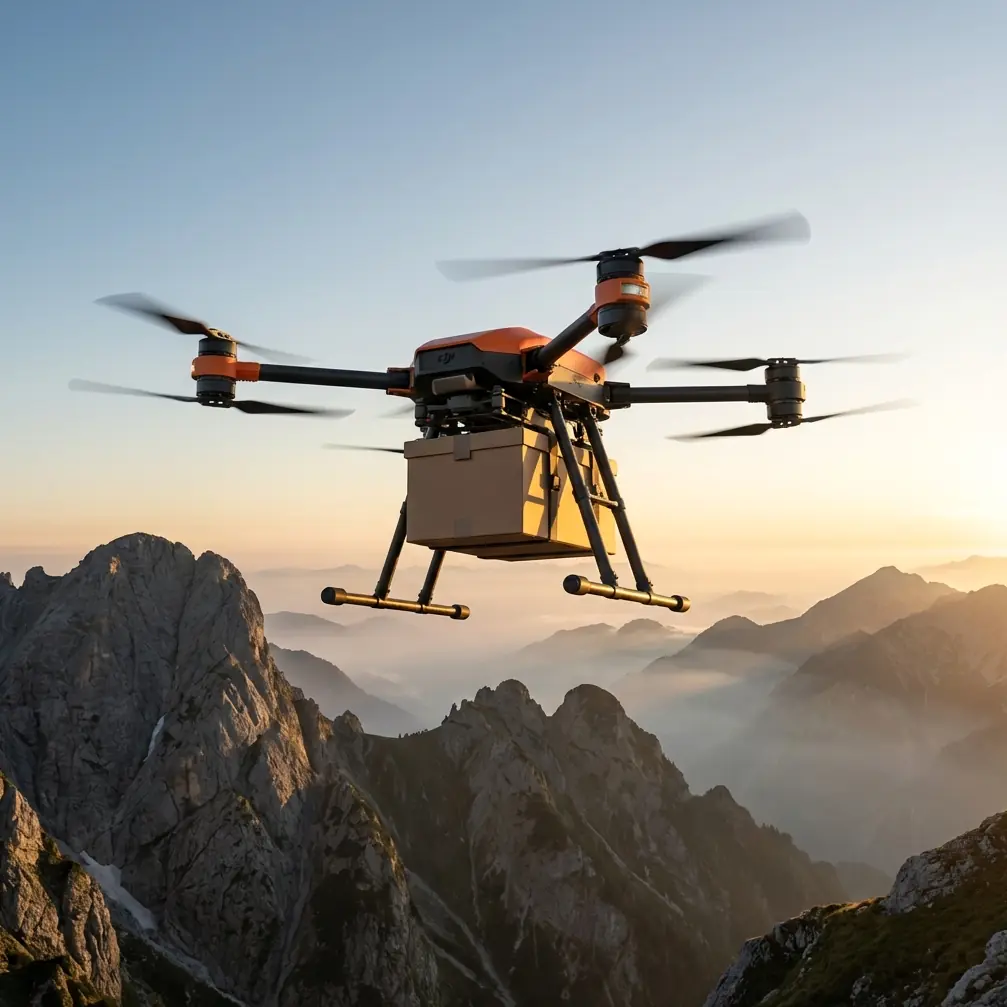
FlyCart 30 for Mountain Solar Farm Surveying: The Altitude, Battery, and Route Decisions That Actually Matter
META: A field-focused tutorial on using DJI FlyCart 30 for mountain solar farm surveying, including optimal flight altitude, route planning, winch logic, battery considerations, and why domestic lithium supply trends matter for long-term drone operations.
Mountain solar farms expose every weak assumption in a drone workflow.
Flat-land habits break quickly. Wind behaves differently from one ridge to the next. Access roads are often narrow or unreliable. Panel rows can stretch over steep grade changes that distort line of sight, radio quality, and energy use. If you are planning to use the FlyCart 30 in this environment, the right question is not simply whether the aircraft can fly there. The real question is how to structure the mission so the platform’s transport design, battery architecture, and route discipline work in your favor.
I approach this as a logistics problem first. That mindset matters because the FlyCart 30 is not just another airframe. It is a heavy-lift system, and when you deploy it around mountain solar assets, every choice about altitude, payload ratio, and landing method compounds into either a smooth operation or a string of inefficient sorties.
This tutorial focuses on one practical scenario: surveying a solar farm in mountainous terrain with FlyCart 30 support. That may include moving sensors, replacement parts, communications gear, or site materials between ridgelines and array blocks while also gathering visual or operational observations. The aircraft’s value here is not abstract. It comes from reducing foot travel, minimizing vehicle repositioning, and helping teams maintain tempo across difficult topography.
Start with the mission profile, not the aircraft brochure
A mountain solar survey usually involves three parallel needs:
- Reaching elevated or isolated array sections without ground delay
- Maintaining stable, repeatable routing across changing terrain
- Preserving enough power margin for safe recovery in shifting wind conditions
That third point is where many teams get caught out. In mountain work, the battery is not just a fuel source. It is your margin against terrain-induced inefficiency.
This is why one piece of industry news deserves more attention than it first appears to get. A 2026 report covered a new U.S. Geological Survey finding that lithium deposits in the eastern United States could potentially meet domestic demand for generations. On the surface, that sounds like a macroeconomic story about energy storage and electric vehicles. For UAV operators, especially those working with battery-intensive platforms, it points to something more operational: the long-term resilience of the battery ecosystem.
The same report also made clear that a lithium deposit alone does not solve the whole problem. Key gaps still remain in the U.S. battery supply chain for building products fully domestically. That distinction matters. If you run a drone program built around electric aircraft, your real dependency is not only on raw lithium availability. It is on the full chain: refining, cell production, pack integration, quality control, transport, and service support.
For FlyCart 30 operators, that affects fleet planning in a very practical way. Heavy-duty survey and logistics work in mountains puts repeated stress on batteries through climbs, hover events, route variation, and weather-related contingencies. A healthier domestic material base could improve long-range supply confidence, but incomplete battery-chain localization means operators should still plan carefully around pack availability, lifecycle management, and redundancy.
In plain terms: don’t build a mountain survey workflow that depends on perfect battery replenishment assumptions.
The optimal flight altitude for mountain solar surveying
Let’s get to the key field question.
For surveying solar farms in mountain terrain with a FlyCart 30, the best working altitude is usually 30 to 50 meters above the local array surface or terrain-adjusted working plane, not a fixed height above the launch point.
That distinction is everything.
A fixed launch-relative altitude can become unsafe or inefficient as the aircraft crosses ridges, drainage cuts, access roads, and terraced panel zones. A terrain-aware operating band gives you enough vertical separation to clear trackers, poles, stringing infrastructure, and localized obstacles while keeping the aircraft low enough to maintain useful visual context and reduce unnecessary energy consumption.
Why 30 to 50 meters?
- Below that range, the aircraft may spend too much time reacting to micro-topography, gust interference, and obstacle complexity.
- Above that range, you often lose efficiency in a mountain survey because the aircraft climbs into stronger wind layers and sacrifices close operational awareness of the array environment.
- Within that range, you usually get a workable compromise between visibility, route precision, obstacle margin, and power discipline.
If your survey task includes visual inspection support rather than just transport, I would bias lower in that band when terrain and obstacle clearance allow it. If the mission is primarily inter-zone logistics with frequent ridge transitions, I would bias higher.
The important word is local. Always think in terms of altitude above the relevant terrain segment, not one universal number for the entire property.
Why route optimization matters more than speed in mountain work
On paper, operators often chase faster completion times. In mountain solar environments, that is usually the wrong metric.
The better objective is route stability.
A stable route reduces:
- repeated climbs and descents
- hover corrections in rotor-disturbed air
- wasted lateral movement around terrain surprises
- battery draw variability from leg to leg
This is where FlyCart 30 mission planning should borrow from linehaul logistics, not just aviation. You want routes that are predictable, divisible into clean segments, and easy to abort or resume.
My preferred structure is a hub-and-spoke layout:
- Establish one secure staging point near the most accessible central service corridor
- Define repeatable spokes to upper, mid-slope, and lower array zones
- Avoid diagonal traverses across multiple elevation bands unless the site geometry truly demands them
That approach makes battery use more consistent and simplifies crew coordination. It also helps if you later transition toward BVLOS-oriented thinking, even if your current operation remains within a stricter visual framework. The discipline required for beyond visual line of sight readiness starts with predictable routing, robust contingency zones, and minimal improvisation.
In mountain solar surveying, route optimization is not software decoration. It is how you keep sorties repeatable when weather shifts and crews rotate.
Use the winch system to remove bad landing decisions
One of the most useful tools in this scenario is the winch system.
Mountain solar farms are full of awkward ground surfaces: rock, scrub, drainage edges, loose gravel, steep cut-ins, cable trays, and irregular maintenance pads. For many delivery-support tasks during a survey, forcing a landing close to the work zone introduces unnecessary risk and time loss.
The winch lets you keep the aircraft in a stable hover above a workable drop point while transferring payload to the ground team below. Operationally, that changes three things:
1. It preserves safer stand-off from poor touchdown areas
You avoid landing on sloped or debris-littered surfaces that could destabilize the aircraft.
2. It shortens site interaction time
Ground teams can receive tools, sensors, or replacement components without preparing a full landing zone.
3. It improves route continuity
The aircraft can complete a planned logistics loop without repeated descent, touchdown, and takeoff cycles.
For mountain solar surveying, this is often a better use of the FlyCart 30 than trying to mimic a conventional landing-based shuttle. The aircraft’s transport logic is strongest when you let it stay airborne and use controlled transfer methods where the terrain is working against you.
Think hard about payload ratio
Heavy-lift capability can tempt teams to use every bit of available carrying capacity. On mountain sites, that is a mistake.
The payload ratio should be set conservatively because elevation changes and wind loading can erase your energy margin faster than expected. If your mission design assumes maximum carriage on every leg, then your route plan has no tolerance for:
- headwind on the return
- reroute around a no-fly site segment
- hover delay while the ground team clears the receiving area
- missed approach due to obstacle encroachment
A better strategy is to tune payload to route complexity. Use fuller loads on short, clean legs between well-characterized zones. Reduce load weight on ridge-crossing sectors or routes with uncertain local airflow.
This is where the dual-battery concept becomes operationally meaningful. Redundancy and sustained power availability are helpful, but they are not permission to plan aggressively. In mountain surveying, dual-battery architecture should be treated as a resilience feature, not an excuse to cut margins too close.
Emergency parachute planning is not a footnote
When people discuss safety systems, they often do it in generic terms. On a mountain solar farm, the emergency parachute deserves direct planning attention.
The terrain itself raises the stakes. A descent event near panel infrastructure, steep embankments, maintenance roads, or inverter stations can produce secondary damage even if the aircraft’s core protective systems activate as designed. That means the mission planner should identify route sections where an emergency descent would create the least site impact.
In practice, this means:
- preferring transit corridors over denser equipment clusters
- avoiding prolonged hover over critical hardware fields when alternatives exist
- selecting transfer points with cleaner ground below whenever possible
The parachute is not part of your normal workflow. But route design should acknowledge where its deployment would be least disruptive if the worst day shows up.
Battery strategy in light of the lithium supply story
Let’s return to the U.S. lithium development because it has direct relevance here.
The report’s strongest factual point was that eastern U.S. lithium deposits could meet domestic demand for generations. For electric drone operations, especially on power-hungry platforms, that hints at a future with more secure domestic raw material access. That is good news for organizations trying to reduce long-term supply uncertainty around energy storage.
But the same report also stressed that major gaps still exist in the battery supply chain. That is the operational caution. A drone program does not run on geology. It runs on available, qualified battery products and the service ecosystem behind them.
So if you are building a FlyCart 30 program for remote solar assets, your battery plan should include:
- sufficient rotation inventory for field operations
- conservative cycle tracking
- temperature-aware charging and storage procedures
- route planning that does not rely on ideal replenishment timing
- contingency assumptions for battery replacement lead time
The broader lithium picture may be improving. The pack-level reality still requires discipline.
Practical altitude workflow for the mountain solar scenario
If I were standardizing a FlyCart 30 procedure for this exact use case, I would train crews to use the following altitude logic:
Transit between zones
Operate around the upper end of the 30 to 50 meter above local terrain band when crossing uneven ridges or passing over sparse obstacles.
Close-in survey support over panel blocks
Shift toward the lower end of that band when visual fidelity and precise site observation matter more than transit speed, assuming obstacle clearance remains comfortable.
Winch deliveries to field teams
Hold enough height to keep rotor wash from disrupting loose site material, while still maintaining controlled payload lowering and visual confidence over the drop area.
Gusty slope faces
Add margin. Mountain airflow can change quickly near escarpments and cut slopes. If the aircraft is working too low in those areas, correction effort increases and efficiency falls.
This is not a single fixed number because the site itself is not fixed. The correct altitude is the one that respects terrain shape, infrastructure density, and wind behavior at that specific section of the farm.
What crews should check before launch
For this scenario, my preflight priority list is simple:
- Terrain-based route segmentation confirmed
- Landing zones and winch transfer points clearly assigned
- Payload ratio matched to the hardest leg, not the easiest one
- Return battery margin calculated with wind and elevation in mind
- Emergency parachute impact corridors considered
- Communications plan aligned with ridge and slope interference risks
If your team wants a second set of eyes on route structure or operational setup, you can message a FlyCart workflow specialist here.
The real role of FlyCart 30 on a mountain solar site
The FlyCart 30 is most effective here when used as an aerial logistics layer inside a survey operation, not just as a flying camera substitute and not just as a brute-force carrier.
Its strongest contribution is tempo.
It moves equipment, supports distributed crews, reduces wasted climbing and driving, and creates a more connected workflow across a site that naturally wants to fragment your team. In mountain solar work, that kind of continuity is often worth more than peak payload on paper.
And if the wider battery supply picture improves over time, as the new USGS-backed lithium findings suggest it may, that only strengthens the case for electric drone operations in remote industrial environments. Still, the unresolved battery-chain gaps are your reminder to plan around present realities, not future headlines.
For now, the winning FlyCart 30 strategy is straightforward: fly terrain-aware, keep altitude local, use the winch instead of forcing bad landings, protect battery margin, and treat route optimization as the backbone of the mission.
Ready for your own FlyCart 30? Contact our team for expert consultation.